








What is the story about?
MADRID (AP) — Health officials are tracking over two dozen passengers from a cruise ship affected by a hantavirus outbreak that resulted in the first fatality
onboard. The ship's operator and Dutch authorities reported that these individuals left the vessel without undergoing contact tracing nearly two weeks after the incident. Health authorities across at least four continents are now attempting to reach the cruise passengers who disembarked on April 24, monitoring their health and tracing others who may have interacted with them since their departure.
Public Health Risk Assessment
The World Health Organization (WHO) has assessed the public health risk as low, noting that hantavirus primarily spreads through contaminated rodent droppings and is not easily transmissible between humans. Dr. Abdirahman Mahamud, the WHO's alert and response director, stated, “We believe this will be a limited outbreak if the public health measures are implemented and solidarity is shown across all countries.”Infected Passenger Developments
On Thursday, the Dutch health ministry reported that a flight attendant on a plane who had briefly boarded with an infected passenger in South Africa exhibited symptoms of hantavirus. The infected passenger, a Dutch woman, was too ill to travel and subsequently died in Johannesburg.If confirmed positive for hantavirus, she could be the first individual not aboard the MV Hondius to contract the virus during this outbreak. Three passengers have died from the outbreak, with several others exhibiting symptoms that typically manifest between one and eight weeks post-exposure.
Evacuations and Monitoring
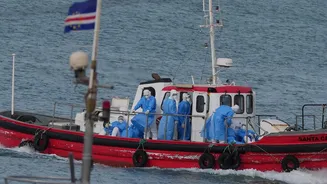
As of Wednesday, three individuals, including the ship's doctor, were evacuated from the vessel while it was near Cape Verde, receiving treatment in specialized hospitals in Europe. The body of the first passenger to die, a Dutch man, was removed from the ship on April 24, coinciding with his wife's disembarkation. She later died in South Africa.While Oceanwide Expeditions reported that 29 passengers left the ship at St. Helena, the Dutch Foreign Ministry estimated the number to be around 40. The company had not previously disclosed that dozens had departed on April 24.
Confirmed Cases and Ongoing Monitoring
The WHO confirmed the first case of hantavirus on the ship on May 2, involving a British man who was evacuated to South Africa from Ascension Island three days after the St. Helena stop. He is currently in intensive care.Recent developments included a positive hantavirus test for a man in Switzerland who disembarked at St. Helena. Singaporean health authorities are monitoring two men who traveled from St. Helena to South Africa and then returned home. Both are being isolated and tested, with one displaying mild symptoms.
British health officials reported that two passengers who returned home during the journey are self-isolating, although they are not symptomatic. Contacts of these individuals are also being traced.
Flight Tracing Efforts
Authorities in South Africa are focusing on tracing contacts from an April 25 flight from St. Helena to Johannesburg, which the deceased Dutch woman briefly boarded. It remains unclear how many other cruise passengers were on this flight, which operates weekly and typically carries around 88 passengers.Currently, the ship is en route to Spain's Canary Islands, carrying more than 140 remaining passengers and crew members. WHO Director-General Tedros Adhanom Ghebreyesus reported improved morale aboard the ship since its resumption of movement.
Investigation into Hantavirus Source
Tests have confirmed that at least five individuals aboard the ship were infected with the Andes virus, a hantavirus found in South America that can spread between humans. Argentina's health ministry reported a significant increase in hantavirus-related deaths last year, and investigations are underway to trace the outbreak's origins, particularly focusing on the couple who were the first cases and their travels through Argentina, Chile, and Uruguay.The WHO has coordinated efforts with health authorities in Argentina to better understand the couple's movements and has arranged for the shipment of 2,500 diagnostic kits to laboratories in five countries.