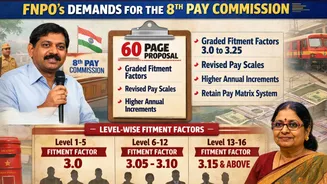










The Federation of National Postal Organisation (FNPO) has formally shared its demands before the National Council (Joint Consultative Machinery, Staff
Side), listing what it believes should form the backbone of the upcoming 8th Pay Commission’s recommendations for postal employees. One of the main asks listed in the proposal is a graded fitment factor framework to address long-standing pay disparities across different employee levels. In a detailed 60-page submission, FNPO Secretary General Sivaji Vasireddy, who is also a member of the NCJCM (Staff Side), listed suggestions spanning pay scales, salary structure, increments, allowances, promotions, and the continuation of the existing pay matrix system. The document is intended to feed into the collective recommendations that central government employee bodies are preparing for the next pay panel. Vasireddy told The Economic Times Wealth that NCJCM plans to meet draft committee members on February 25, 2026, after compiling feedback from various employee organisations. Following this discussion, a consolidated draft will be sent to the 8th Pay Commission chairperson, Ranjana Prakash Desai. According to Vasireddy, the submission will cover the proposed fitment factor, revised minimum and maximum pay, and allowances, including those applicable to railway employees. Why FNPO Wants A Differentiated Fitment Factor A major part of FNPO’s demand is the introduction of multiple fitment factors, ranging from 3.0 to 3.25, instead of a uniform multiplier for all of the levels. The union argues that earlier pay commissions did not apply rationalisation evenly across levels, partly due to structural constraints. “We have recommended our fitment factors based on the Akroyd formula, where we have taken 4 family member units for our calculation,” says Vasireddy, as per the report. The Akroyd formula, made by Dr Wallace Akroyd, estimates minimum living wages by factoring in essential expenses such as nutrition, clothing and housing. It assumes a daily requirement of 2,700 calories for an adult, along with other basic needs. Level-Wise Structure Proposed By FNPO Under FNPO’s plan, for the foundational tiers, known as Group C (Levels 1 to 5), the proposal suggests a uniform rationalisation factor of 3.00. This would elevate the current Level 1 entry pay of Rs 18,000 to a new minimum of Rs 54,000. Similarly, Level 5, which currently sits at Rs 29,200, is projected to rise to Rs 87,600. In the mid-tier segments, which include Group B (Levels 6 to 9) and higher administrative roles, the rationalisation factor increases slightly to 3.05. For Level 6, which marks the entry point for Group B, the current pay of Rs 35,400 would jump to Rs 108,000. This trend continues through Level 9, where the 7th CPC pay of Rs 53,100 is proposed to become Rs 162,000. For senior leadership and executive roles, the multipliers become more aggressive to account for increased responsibilities. Group A Entry (Level 10) through Level 12 utilises a factor of 3.10, pushing a Level 10 salary from Rs 56,100 to Rs 174,000. While Levels 13 and 13A revert briefly to a 3.05 factor, the high-level HAG and HAG+ scales (Levels 14 to 16) see factors ranging from 3.15 to 3.20. This would result in Level 16 (HAG+) pay rising from Rs 205,400 to a substantial Rs 657,300. At the very top of the government hierarchy, the Apex Scale (Level 17) and the Cabinet Secretary (Level 18) receive the highest rationalisation factor of 3.25. Under this proposal, the Apex Scale would move from Rs 225,000 to Rs 731,300. Finally, the Cabinet Secretary's pay, the highest in the structure, would see an increase from Rs 250,000 to a proposed Rs 812,500. The union maintains that this graduated model follows the logic adopted by previous pay commissions, including the 7th CPC, and ensures internal balance within the pay matrix. Push For Higher Annual Increments And Pay Matrix Continuity Beyond fitment factors, FNPO has also urged the government to raise the annual increment rate from the current 3 per cent to 5 per cent. The organisation believes this change would provide more meaningful income growth, ease stagnation concerns, and align government salaries more closely with other organised sectors. This proposal is particularly significant for Group C and D employees, where promotional avenues are limited and annual increments form a crucial part of salary progression, alongside dearness allowance and periodic pay commission revisions. FNPO has also asked for the retention of the 7th Pay Commission’s pay matrix system, citing its role in bringing transparency and predictability to pay fixation and reducing disputes related to anomalies.