









What is the story about?
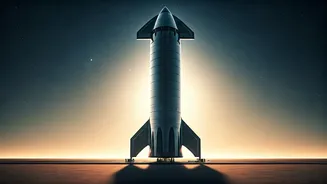
SpaceX successfully launched its most powerful Starship to date on Friday, an upgraded model that NASA plans to use for landing astronauts on the moon.
This test flight marks a significant step in the company's efforts to support NASA's Artemis program. The mega rocket lifted off from southern Texas, just two days after SpaceX CEO Elon Musk announced plans to take the company public. During the hourlong flight, the spacecraft released 20 mock Starlink satellites before ultimately landing in the Indian Ocean, despite experiencing some engine difficulties.
Launch Details and Performance
The spacecraft reached its intended destination, the Indian Ocean, although it erupted in flames upon impact, a result that SpaceX anticipated. Musk described the launch as 'an epic' event, stating, 'You scored a goal for humanity' in a message to his team via X.This test flight was the twelfth for the Starship, which Musk envisions as a vessel for future Mars missions, with lunar missions being the immediate focus. NASA Administrator Jared Isaacman attended the launch, emphasizing that Starship is now closer to fulfilling its lunar objectives.
Technical Specifications and Innovations
The latest Starship model, standing at 407 feet (124 meters), surpasses its predecessors in height and engine thrust. The upgraded booster features fewer but larger grid fins for improved steering and a more robust fuel transfer line, comparable in size to the Falcon 9 first-stage booster.Additionally, the spacecraft is equipped with enhanced navigation and computer systems, as well as docking cones intended for future lunar missions. The aim of Starship is to achieve full reusability, although this test did not include recovery efforts for the returning rocket stages.
Future Lunar Missions and SpaceX's Plans
NASA is investing billions in both SpaceX and Jeff Bezos’ Blue Origin for lunar lander development, with both companies vying to be the first to deliver astronauts to the moon. While SpaceX's Starship has successfully reached the edge of space, Blue Origin's prototype, Blue Moon, is still under preparation for a future lunar mission.NASA's Artemis program includes plans for a docking trial run in orbit around Earth next year, where astronauts will practice connecting their Orion capsule with either Starship or Blue Moon. The first crewed lunar landing could occur as soon as 2028, depending on which lander proves to be safer and ready first.
Commercial Prospects and Space Tourism
SpaceX is also accepting reservations for private flights to the moon and Mars aboard Starship. Notably, California businessman Dennis Tito and his wife have signed up for a lunar flight, although the timeline remains uncertain.Recently, Chinese-born bitcoin investor Chun Wang announced plans to fly to Mars on Starship's inaugural interplanetary mission. He had previously chartered a SpaceX polar flight in a Dragon capsule, marking a significant milestone in his journey as a space tourist.