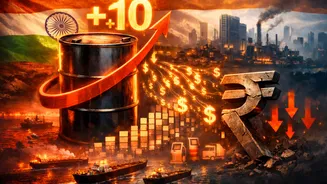




India imports nearly 88% of its crude oil requirements, with around 46% sourced from key West Asian countries, making it sensitive to supply-side disruptions
and price volatility. A report by Rubix Data Sciences has estimated that every $10 per barrel increase in crude prices raises India’s annual oil import bill by $13–14 billion, with knock-on effects on inflation and external balances. India’s total merchandise trade with West Asia stood at USD 220 billion in FY2025, with imports significantly exceeding exports, resulting in a structural trade deficit driven largely by energy dependence. Also Read: Ceasefire Cracks, Oil Surges: Will Crude Spike to $150? Remittances, another key linkage, could also see near-term variability, the report said. As per the data, India received a record USD 135.4 billion in remittances in FY2025, with nearly 38% originating from Gulf Cooperation Council (GCC) countries. In FY2025, India’s goods imports from the 13 major West Asian countries stood at USD 155 billion and exports at USD 66 billion. The share of the 13 major West Asian countries in India’s goods imports has declined from 24% in FY2022 to 21% in FY2025. However, India’s export share to these countries has increased from 13% in FY2022 to 15% in FY2025. "Any prolonged uncertainty in regional economies, particularly in sectors employing large numbers of Indian workers, could affect income flows," Rubix Data Sciences in its report said. On the investment front, from April 2000 to December 2025, cumulative foreign direct investment inflows from West Asia into India stood at USD 31.7 billion, led by sovereign backed funds from the UAE and Saudi Arabia. While flows have remained steady so far, sustained uncertainty could slow the pace of new investments and capital deployment. A significant portion of the capital is deployed by state-backed investors such as Abu Dhabi Investment Authority (ADIA), Mubadala Investment Company, and Saudi Arabia’s Public Investment Fund, focusing on long-term strategic assets.