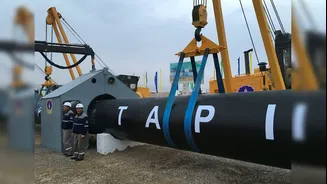






Turkmenistan should by the end of the year complete a section of gas pipeline to the Afghan city of Herat that it hopes will unlock international financing,
despite security challenges, to extend the route as far as India, officials told Reuters. Turkmen officials say the pipeline section, under construction since 2024, should start pumping gas as far as Afghanistan’s third city in early 2027. With an estimated cost of $600 million, according to Afghan media, the Herat leg is part of a wider project with a planned annual capacity of 33 billion cubic metres, 66 times as large as the 500 million cubic metres Turkmen officials say Afghanistan is expected to initially purchase yearly. That would leave ample spare capacity to ship gas to the much bigger markets of Pakistan and India, which together import around 45 to 50 bcm of natural gas annually, almost all of which is LNG imported by sea. Analysts, investors and industry figures have long said the Turkmenistan–Afghanistan–Pakistan–India project, or TAPI for short, is unrealistic given the conflict in Afghanistan and enmity between India and Pakistan. So far, Turkmenistan has provided the funding. Analysts have estimated the total cost of TAPI to be around $10 billion and said investors would be wary because the international community, including Turkmenistan, has refused to recognise the Taliban government in Afghanistan. But Turkmenistan hopes increased energy prices and heightened demand for alternatives to Middle Eastern supplies as a result of the US-Israeli war with Iran may spur renewed interest in diversifying energy supplies, the officials said. For Turkmenistan, holder of the world's fourth-largest gas reserves and almost entirely dependent on China as a customer for its exports, extending the pipeline would give it new markets. Afghanistan’s state-owned gas company said in August it had signed a preliminary deal to buy gas shipped to Herat, but did not specify a price. In response to a request for comment, the office of the Taliban governor of Herat province said: “TAPI brings with it the promise of economic growth, job creation, and the development of the country's infrastructure.” Muhammetmyrat Amanov, head of the Turkmen state company responsible for the pipeline project, told Reuters the Herat section should “provide early revenue streams and increase confidence among lenders”. He cited the Asian Development Bank and Islamic Development Bank as possible funders. The Islamic Development Bank did not reply to a request for comment, while the Asian Development Bank was noncommittal. It told Reuters it had paused regular assistance to Afghanistan after the Taliban's return to power in 2021, but that it remained engaged with the TAPI project. "Any decision by ADB to provide technical assistance or financing would depend on the circumstances at the time and be subject to due diligence and applicable ADB approvals," it said. Turkmenistan says it has welded and laid around 124 kilometres (77 miles) of the 153-km Serhetabat-Herat section. While that has nearly completed the Afghan part, it represents less than a tenth of the planned 1,800-km route to Pakistan and India. A Western diplomat based in Ashgabat, who spoke on condition of anonymity, said: “From a purely commercial perspective, maximising exports to China might seem the obvious and least risky option.” “But from Ashgabat's perspective, excessive dependence on a single buyer is an existential strategic risk. It gives that buyer enormous leverage over the country's economy.” Other export diversification options, including a trans-Caspian route to Europe, face political and technical challenges, primarily related to demarcation of the seabed frontier. Security conditions in much of Afghanistan have improved since the Taliban returned to power in 2021 and Ashgabat maintains relatively friendly ties with Kabul even though it does not formally recognise the Taliban government. Across the border, Pakistan's longstanding rivalry with India, as well as its present conflict with the Taliban authorities in Afghanistan, remains an obstacle to completion of the full project. Additionally, a separatist insurgency in Balochistan that has lasted for decades and is intensifying, poses problems, as the pipeline's route would run through the Pakistani province. Pakistan’s ambassador in Turkmenistan, Faryal Leghari, told Reuters that Islamabad remains interested in the TAPI pipeline, as well as a complementary project to ship Turkmen gas to Pakistan's ports of Gwadar and Karachi for further export as seaborne LNG. India's foreign ministry did not immediately respond to a request for comment. The Western diplomat in Ashgabat said mobilising international financing would be extremely difficult, but that Ashgabat was not abandoning the attempt. “It is willing to commit its own resources to building the pipeline infrastructure up to the Afghan border and even some distance beyond it, in the hope of keeping the project alive and eventually attracting partners,” the diplomat said.