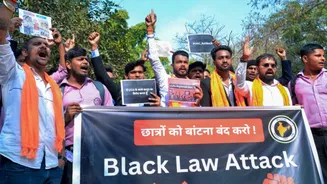

On January 13, the University Grants Commission notified the UGC (Promotion of Equity in Higher Education Institutions) Regulations, 2026. This will replace
the UGC (Promotion of Equity in Higher Education Institutional) Regulations, 2012. While many have welcomed the guidelines for expanding the definition of equal opportunities to include Persons with Disabilities (PwD), Other Backward Classes (OBC), Scheduled Castes (SC), Scheduled Tribes (ST), and women, it has also drawn criticism, mainly from students from the general category. A tweetstorm using the hashtag ‘UGCRollback’ trended, with many people calling the regulation a ‘Black Law’. Their claim is that the regulation presumes students from the general category to be ‘potential criminals’, as the burden of proof lies on them if a complaint against them is filed by any student from a marginalised category. Talking to the news agency Press Trust of India (PTI), Anuj Tripathi, a student of Udai Pratap Autonomous College, Varanasi, said, “We strongly oppose this. People from all castes come here to study. If you only consider one perspective, if you believe that only the upper castes are oppressing others, that’s not true. If the UGC law is passed, our mutual affection will end because people will start fearing us. They will be afraid to sit with us or interact with us. We will also be afraid of them, thinking, ‘If we sit with them and they unintentionally involve us in some dispute, what will we do?’ There is pressure from everyone’s family to stop associating with someone if they are considered wrong.” Read More: What Are the UGC Equity Regulations 2026? Key Changes, Powers, and Concerns Explained
What Is The UGC Regulations 2026?
The guidelines state the need to “eradicate discrimination only on the basis of religion, race, gender, place of birth, caste, or disability, particularly against the members of Scheduled Castes and Scheduled Tribes, socially and educationally backward classes, economically weaker sections, persons with disabilities, or any of them, and to promote full equity and inclusion amongst the stakeholders in higher education institutions”.
What has driven the most backlash is Clause 8 of the regulation, which states: “The aggrieved person shall also have the option of reporting the incident to the Equity Helpline. The information received on the helpline shall be forwarded to the police authorities concerned, if prima facie, a case under the penal laws is made out.”
This has been interpreted by many as a way to misuse the law, that is, filing false cases, as an X user and self-claimed ‘GC activist’, @neha_laldas, calls it an “opening floodgate for the SC/ST Act on campuses”.
UGC Regulations 2026: Ground Report
Abha Dev Habib, an associate professor at the University of Delhi, however, says, “It is like saying that bringing a sexual harassment act puts all men under a scanner, or that a dowry law puts all husbands under a scanner, so these laws should not be introduced.” She points out that these acts and laws are based on society’s structure. However, she also notes that the regulations miss out on students from religious minorities. “There has been an increase in hate crimes, and students from religious minorities also need to feel safe.”
However, Anuradha Tiwari, who posted a video on X and is the founder of the Dharma Party of India, which claims itself to be India’s first political front committed to ‘merit, equality and development’, says that since students from the SC, ST and OBC categories are protected, “students of the general category will now be living under fear. Out of this very fear, they will not speak to students from the SC, ST and OBC categories. Then people will say this is also a form of discrimination because SC, ST and OBC students are isolated and not interacted with. Then, out of fear of such discrimination cases, the general category student will drop out of college”.
Commenting on this, a Delhi-based sociologist Ankush, who is researching urban spatiality and caste epistemology, questions the ‘fear’ people are talking about. “Those who are complaining about being branded as ‘potential criminals’ confuse me, to be honest.” He points out that a plea has been filed by an advocate stating that these latest regulations fail to account for discrimination against “upper-caste folks”. “I would like to know, and this is in good faith, whether there is documented evidence of discrimination against upper-caste groups?”
What Does The Data Say?
When asked about false cases, an advocate practising in the Delhi High Court, on condition of anonymity, says, “Accusing someone comes with proper investigation.” Furthermore, the advocate notes, “Before this regulation, and even as of now, the majority of students in a college belong to the general category, and despite reservations, students from SC, ST and OBC categories have had a disadvantage in almost everything possible.”
Citing data from the Ministry of Social Justice and Empowerment, 2024, the advocate notes that in almost all states and Union Territories, registered cases against SCs and STs increased from 2020 to 2022. Ankush also quotes data from a study conducted by the Dalit Human Rights Defenders Network (DHRDNet), Human Rights Law Network (HRLN) and the National Council of Women Leaders (NCWL), which notes that between 1991 and 2021, crimes against the SC and ST communities rose by 177.6 per cent and 111.2 per cent, respectively.
Ankush also questions, “Why isn’t there ever an agitation against the ever-increasing disproportionate number of seats in public sector education and the number of candidates? Why was there an issue against proportional representation?”
UGC Regulations 2026: Ambiguities
The right-wing student organisation Akhil Bharatiya Vidyarthi Parishad (ABVP), in its official statement, notes that while it welcomes the new regulation, it believes “that clarity and balance in the regulations are absolutely essential”. The release states, “The ABVP urges the UGC to take immediate cognisance of the ambiguity and misconceptions currently prevailing among society, students and parents regarding some provisions and terminology of this regulation, and to take prompt action to prevent any kind of divisive situation.” However, the exact ambiguities are not pointed out in the release.
Speaking on the ambiguities, professor Abha Dev Habib points out that the regulation asks the institution to set up a committee to review complaints. However, the members of the committee are not elected, rather nominated. "The Committee should be independent of institutional Head," she says. She furthermore notes that the criteria for nomination too is ambiguous. She also notes that this regulation may provide a space to create vigilante groups, which in response could create a counter vigilante group and this must be avoided.
She also notes that bringing in a regulation is not enough and that it must be implemented properly. Ankush seconds this. “The UGC regulations that were just introduced are surely a welcome move, at least on paper, but my concerns range from the fact that there have been pieces of excellent legislation previously introduced, such as the SC/ST Act, but their implementation remains a question.”
Times Now reached out to the left-wing student organisation Students’ Federation of India (SFI) for a statement. The piece will be updated upon receiving any further response.