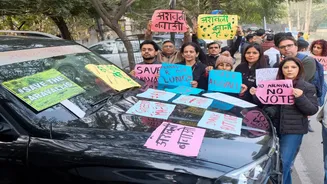








Congress workers and several social and environmental organisations staged protests across Rajasthan on Monday, demanding stronger protection for the Aravalli
mountain range amid controversy over a new definition approved by the Supreme Court of India. Demonstrations were reported from Udaipur, Sikar, Jodhpur and Alwar. In Udaipur, protesters clashed with police outside the district collectorate, where some agitators were detained. Congress workers and members of various groups raised slogans and accused authorities of weakening legal safeguards for the Aravallis. Peaceful protests were also held at Harsh Parvat in Sikar, where environmental activists urged conservation of the ancient range, often described as critical for groundwater recharge, biodiversity and climate balance in the region, reports PTI.
In Jodhpur, National Students’ Union of India (NSUI) workers took to the streets, with some climbing police barricades. In Alwar, Rajasthan Leader of the Opposition Tikaram Jully called the Aravallis the “lungs of Rajasthan” and said the Congress would intensify protests statewide.
Karni Sena and local community groups joined the agitation, demanding a rollback of the court-approved definition. They warned of wider protests if the demand was not accepted. One protester questioned the impact on people and wildlife, asking where displaced residents and animals would go if land use changes followed.
Centre Rejects Mining Allegations
The Centre has strongly denied allegations that the revised definition relaxes protections or promotes mining. Union Environment Minister Bhupender Yadav said more than 90 per cent of the Aravalli region would remain protected under the Supreme Court-approved framework.
The government said mining eligibility would be limited to about 0.19 per cent of the total Aravalli area of roughly 1.44 lakh square kilometres. Yadav also cited a Supreme Court-mandated freeze on new mining leases in the region until a comprehensive Management Plan for Sustainable Mining is finalised.
Officials clarified that the 100-metre criterion does not mean areas below that height are automatically open to mining. Restrictions apply to entire hill systems and enclosed landforms, not just peaks or slopes. They said the standardised definition was meant to remove ambiguity that previously allowed mining dangerously close to hill bases.
Safeguards and Enforcement
According to the Environment Ministry, the new framework includes additional safeguards such as mandatory mapping on Survey of India maps, identification of core and inviolate areas where mining is prohibited, and treating hills within 500 metres as a single range.
The Centre said the primary threat to the Aravalli Range remains illegal and unregulated mining, and recommended stricter monitoring, enforcement and use of technology such as drones and surveillance.