





Israelis will vote on 27 October in the first national election since the Hamas-led attacks of 7 October 2023 and the devastating war in Gaza that followed.
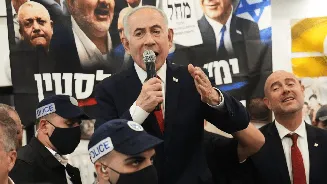
The vote comes as the country remains divided over its political future and the leadership of Prime Minister Benjamin Netanyahu. Critics accuse Netanyahu of failing to prevent the 7 October attacks and undermining Israel's democracy. However, the prime minister retains a strong base of support among voters. The opposition is led by former military chief of staff Gadi Eisenkot. It includes groups spanning the political spectrum, from secular left-wingers and nationalist West Bank settlers to centrist politicians and Palestinian Arab factions. Despite their differences, they share a common objective: removing Netanyahu from power. Here are four possible scenarios that could emerge after the votes are counted: Scenario 1: A Fragile Coalition After the election, President Isaac Herzog will consult party leaders, who will recommend a candidate to form the next government. Herzog will then give the mandate to the person he believes has the best chance of assembling a coalition. For Eisenkot, the most obvious route to power would be an alliance with Netanyahu's other opponents, known as the "change bloc". The group includes right-wing politicians such as Avigdor Lieberman of Yisrael Beiteinu and left-wing figures such as Yair Golan, leader of the Democrats party. A similar alliance came to power in 2021 but collapsed after a year of internal disagreements. Any new coalition bringing together parties with sharply different political positions could face similar difficulties. In 2021, Netanyahu's Likud party and Yair Lapid's centrist Yesh Atid party won the most votes, but neither secured a parliamentary majority. Weeks of negotiations followed. Yesh Atid eventually agreed to a rotation arrangement with Naftali Bennett, leader of the smaller right-wing Yamina party, under which Bennett became prime minister first. The coalition also included Raam, an Arab Islamist party led by Mansour Abbas, giving the alliance a majority. However, the government remained divided. In 2022, defections by Yamina lawmakers led to its collapse and another election in November. Opinion polls suggest Eisenkot may again need support from Abbas and Raam to reach the 61-seat threshold required for a parliamentary majority. But bringing an Arab party into an Israeli governing coalition has become increasingly difficult since the 7 October attacks. Even if Eisenkot's bloc wins the most seats among Netanyahu's opponents, that would not automatically make him prime minister. Other opposition figures, including Bennett and Lieberman, could demand the top job in exchange for their support. Scenario 2: Netanyahu Secures a Majority Another possibility is that opinion polls prove inaccurate and Netanyahu's allies win enough seats to form a government without relying on opposition parties. That happened in 2022, when Netanyahu's bloc secured 64 seats despite receiving about 48% of the overall vote. The result allowed him to establish what was described as the most far-right government in Israel's history. Israel's electoral system requires parties to win at least 3.25% of the vote to enter parliament. Votes cast for parties that fail to cross that threshold do not translate into seats, potentially benefiting rival blocs. In 2022, the left-wing Meretz party and the Palestinian nationalist Balad party failed to cross the threshold, leaving more than 200,000 opposition votes without parliamentary representation. This increased Netanyahu's bloc's relative share of the seats. Netanyahu will be hoping for a repeat of that outcome. Despite years of war and domestic political turmoil, his coalition has remained in power for four years. However, opinion polls suggest his allies are unlikely to repeat their previous success. The electoral threshold could also prove crucial this time, with the new far-right Amcha Yisrael party hovering close to the 3.25% mark in polling. Scenario 3: Another election A third possibility is that neither side can assemble a stable government, leaving Israel facing another round of elections. The country has experienced prolonged political instability before, holding five elections between 2019 and 2022 amid a continuing dispute over Netanyahu's leadership. Current polling suggests Netanyahu's governing bloc could fall well short of the 61 seats needed for a majority. His opponents could theoretically join him in a national unity government, but most have given little indication that they are willing to do so. Such an arrangement could also provoke a backlash from their supporters, who want Netanyahu removed from office. Nevertheless, a major security crisis, such as renewed fighting with Iran, could increase the chances of a temporary national unity arrangement. Following the 7 October attacks, some of Netanyahu's opponents, including Eisenkot, briefly joined him in a war cabinet to support the military campaign in Gaza. Even if the opposition wins enough seats collectively, its internal divisions could prevent it from forming a government. Several seats are expected to go to the Joint List, an alliance representing Israel's Arab citizens, whose political positions are unacceptable to right-wing parties such as Yisrael Beiteinu. The Reservists, a newly established right-wing party, could further complicate coalition negotiations if it enters parliament. The party has pledged to oppose any government that includes either ultra-Orthodox parties, which are among Netanyahu's most likely allies, or Arab parties, which could cooperate with Eisenkot. If negotiations fail, Netanyahu could emerge as the beneficiary of the deadlock. He would remain prime minister in a caretaker government while Israel prepared for another election. Scenario 4: A Minority Government If neither bloc can secure a majority, Eisenkot or another opposition leader could attempt to form a minority government — an uncommon arrangement in Israel. Such a government would need support from Arab parties without necessarily including them formally in the governing coalition.