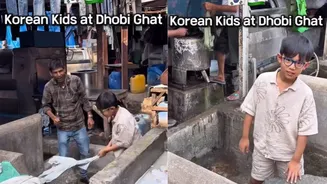

Far from tourist trails and glossy postcards, a quiet moment of cultural exchange unfolded at Mumbai’s historic Dhobi Ghat—captured through the eyes of a South
Korean family living in India. Jung Ae, a South Korean woman who often documents her family’s everyday experiences in the country, recently shared a video showing her young son getting a hands-on introduction to life at the iconic open-air laundry. The clip offers a rare, grounded look at the sheer physical effort that goes into a task most people take for granted: washing clothes. Posted on Instagram with the caption, “Korean kids at Dhobi Ghat, trying real Indian life. Real work. Real respect,” the video shows Jung Ae’s son working alongside local washermen. Under the gentle guidance of a dhobi, the child attempts the traditional washing method—repeatedly flinging wet clothes against stone slabs, a technique that demands both strength and stamina.
The video later cuts to Jung Ae herself stepping in to try the labour-intensive process. As she struggles with the demanding routine, people around her can be seen smiling and watching on, seemingly amused but also appreciative of the family’s genuine attempt to understand the work rather than simply observe it from a distance.
Often described as one of the largest open-air laundries in the world, Dhobi Ghat stands as a powerful symbol of Mumbai’s tireless workforce. Jung Ae’s visit went beyond showcasing a famous landmark; it highlighted the dignity of labour and the unseen human effort that keeps a city running day after day.
The clip struck a chord online, quickly drawing warm reactions from viewers. “So wholesome,” one user commented, while another wrote, “Hard work makes everything fruitful.” Many others praised Jung Ae for using real-life experiences to teach her child empathy, respect for workers, and the value of understanding local cultures—not as spectacles, but as lived realities.