









What is the story about?
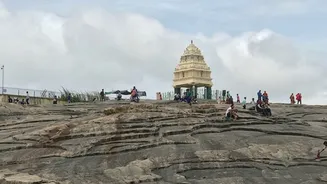
Every morning, joggers run past it. Tourists photograph the Glass House in front of it. Families spread picnic mats beside it. But the giant grey rock
sitting quietly inside Bengaluru's Lalbagh Botanical Garden is not just a rock. It is 3.4 billion years old, older than dinosaurs.. To put that number in perspective: Earth itself is 4.5 billion years old. This rock has been around for three-quarters of that entire time. While the nearby tech campuses of Koramangala and Electronic City race to build the software of the future, this rock remains the city’s original 'hard drive,'storing 3 billion years of planetary data just a short drive from the world's busiest coding hubs.
It was born in hell
The rock formed during the Archean Eon, a period when Earth looked nothing like it does today, say several research and reports. The atmosphere was toxic. Volcanoes covered the surface. Temperatures were extreme. There was no life anywhere.Deep beneath this violent surface, intense heat and pressure were slowly cooking and squeezing minerals together. Quartz and mica got stretched, folded, and baked, like someone kneading dough for billions of years. The result was a metamorphic rock called Peninsular Gneiss, a report by Deccan Herald stated. Stand close to the Lalbagh rock today and you can actually see those ancient folds, dark and light bands swirling through the stone, frozen in time.
It has travelled farther than any of us ever will
Around 300 million years ago, the land beneath Bengaluru sat near the Antarctic Circle, close to the South Pole, as part of a giant supercontinent called Gondwana. Then tectonic plates started moving. Slowly, over millions of years, this chunk of land drifted northward across the entire Southern Hemisphere. It eventually crashed into Asia with such force that the collision pushed up the Himalayas. The Lalbagh rock rode that entire journey and came to rest at 13 degrees North, right where Bengaluru sits today.
Scientists figured out its age using tiny crystals
Geologists aged the rock using microscopic zircon crystals trapped inside it. Zircon crystals are nature's time capsules. They lock in a radioactive signature at the moment they form and never let it go. By measuring that signature, scientists can calculate exactly how old the rock is. This technique confirmed what geologists had suspected: the Lalbagh rock is among the oldest exposed rock surfaces on the entire Indian subcontinent.
In 1975, the Geological Survey of India officially declared it a National Geological Monument, the same status given to the Kutch fossils and the Lonar crater. Most Bengalureans have never heard of this.
It has watched human history too
The rock's story is not only geological. In 1932, archaeologists digging near the rock found prehistoric burial sites. People living in Bengaluru thousands of years ago chose to bury their dead near this rock, possibly because it already felt ancient and sacred even then. They left behind large pottery urns with distinctive rounded bases.
A 15th century hero-stone also stands at the base of the rock, a memorial to a woman who chose to end her life after her husband died. Medieval communities were still gathering around this rock, still treating it as a landmark, still marking their most significant moments beside it.
It is alive right now
The rock is not just stone. Tiny plants, mosses, and rare lichens grow in its cracks. A colourful lizard called the Peninsular rock agama lives on its slopes, its skin the exact grey of the gneiss. Those lichens quietly monitor Bengaluru's air quality and die when pollution rises.
This entire micro-ecosystem took centuries to build. Graffiti scratched into the surface destroys it chemically. Plastic waste left nearby breaks it apart. Most visitors have no idea any of this is happening beneath their feet.
The problem: nobody is told any of this
There is no signage explaining the rock's age. No interpretation board. No QR code. No school curriculum mentions it. The Glass House built in 1889 has heritage protection. The 3.4-billion-year-old rock it stands on has a government monument status that almost no one enforces or communicates.
In a city that tears down and rebuilds itself every few years, this rock has been standing, silently and patiently, since before animals existed on Earth. The least Bengaluru can do is put up a sign.