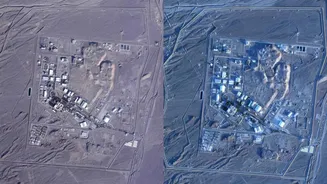

Satellite imagery has revealed fresh activity at two of Iran's key nuclear facilities - Natanz and Isfahan - raising concerns that Tehran may be attempting
to hide what remains after last year's strikes by Israel and the United States. Images captured by Planet Labs PBC show newly-constructed roofs over damaged structures at both sites, marking the first visible activity since Israel's 12-day conflict with Iran in June. The timing comes amid heightened international scrutiny over Iran's violent crackdown on protests.
Roofs To Block Satellite Surveillance?
The coverings effectively block satellite surveillance, currently the only means of monitoring the facilities after Iran denied access to inspectors from the International Atomic Energy Agency (IAEA). Tehran has not publicly addressed the construction, and the UN nuclear watchdog did not respond to requests for comment.
Experts say the move does not indicate reconstruction. Instead, it appears aimed at concealing recovery efforts. Andrea Stricker of the Foundation for Defense of Democracies said the activity likely reflects attempts "to assess whether key assets - such as limited stocks of highly enriched uranium - survived the strikes".
"They want to be able to get at any recovered assets they can get to without Israel or the United States seeing what survived," she said.
Natanz and Isfahan Nuclear Sites
Natanz and Isfahan are central to Iran's nuclear infrastructure. Before the war, Natanz was the main uranium enrichment hub, using advanced centrifuges to enrich uranium up to 60% purity - close to weapons-grade levels. Isfahan, meanwhile, played a crucial role in producing uranium gas used in the enrichment process.
Satellite images show roof construction at Natanz began in December over the heavily damaged Pilot Fuel Enrichment Plant, which the IAEA previously described as "functionally destroyed" following Israeli and subsequent US strikes. Iran has offered no public explanation, and the site's electrical system appears to remain inoperative.
Imagery also shows continued excavation near Natanz at Kuh-e Kolang Gaz La, or "Pickaxe Mountain", where analysts believe Iran may be developing a new underground nuclear facility.
At Isfahan, a similar roof was completed in early January over a structure near the site’s northeast corner. While the building’s purpose is unclear, Israel previously said its strikes there targeted centrifuge-related facilities.
Additional satellite images show tunnels near Isfahan being sealed or reinforced, a tactic Iran has used before to protect against missile attacks.
Beyond Natanz and Isfahan, Iran has also moved quickly to rebuild parts of its ballistic missile and military infrastructure. Recent satellite photos show construction underway at the Parchin military complex, including a site known as “Taleghan 2,” which Israel struck in October 2024.
Iran has continued to insist its nuclear program is peaceful, even as international concern grows over the opacity surrounding its post-strike activities.
(With inputs from AP)