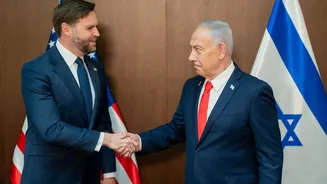






US Vice President JD Vance and Israeli Prime Minister Benjamin Netanyahu held a private meeting in Washington this week to address growing disagreements
over the Iran conflict and US policy towards Tehran, according to an Axios report. The meeting took place at Blair House and was described by officials from both sides as "direct" and "frank", reflecting months of tensions between the two leaders over the handling of the Iran war. Netanyahu Raises Concerns Over Vance's Criticism According to a senior Israeli official, Netanyahu used the meeting to express concerns about Vance's recent public criticism of Israel, the Israeli government and the country's standing within the Republican Party. "It was a frank and candid conversation," the Israeli official was quoted as saying. A US official similarly described the discussion as "direct", indicating that both sides openly addressed their differences. Rift Grew Over Iran Policy Although President Donald Trump's administration has continued to publicly support Israel, Vance has reportedly become one of the strongest advocates within the administration for pursuing diplomacy with Iran. As the conflict continued, Vance increasingly questioned Netanyahu's approach to the war and played a larger role in shaping Washington's Iran policy. According to the report, Vance strongly backed the US-Iran memorandum of understanding aimed at limiting Iran's nuclear programme, an agreement Netanyahu reportedly opposed privately but avoided criticising publicly in the hope that it would ultimately fail. Public Remarks Deepened Tensions The report says Netanyahu became frustrated by Vance's public comments, particularly after the vice president suggested the Israeli leader was encouraging opposition to the Iran agreement and questioned his loyalty to President Trump. Israeli officials also reportedly viewed Vance's growing influence over US policy on the conflict with concern. On the other hand, Vance believed that individuals aligned with Netanyahu in both Israel and the United States were attempting to undermine him politically. Officials familiar with the discussions said Tuesday's meeting helped reduce tensions before they escalated further. Vance Favoured Diplomacy Over Military Escalation The report also describes earlier disagreements between the two leaders. During a phone conversation in March, Vance reportedly challenged Netanyahu's assessment of the conflict, arguing that several Israeli predictions—including expectations of a popular uprising inside Iran—had not materialised. Following the April ceasefire, Vance became one of the administration's strongest supporters of renewed diplomacy with Tehran. He has repeatedly argued that the Trump administration's priority should be preventing Iran from obtaining a nuclear weapon while avoiding another prolonged US military conflict in the Middle East. Vance Issued Public Warnings to Israel As debate over the Iran agreement intensified, Vance publicly cautioned Israeli leaders against criticising Washington's diplomatic efforts. In June, he said Israel should avoid attacking "the only powerful ally" it had, referring to the United States. A month later, during an appearance on Joe Rogan's podcast, Vance accused some members of the Israeli government of attempting to influence US policy in favour of prolonging the conflict rather than supporting diplomatic negotiations. During the same interview, Vance also claimed that convicted sex offender Jeffrey Epstein had links to "the highest levels of Israeli intelligence", although he did not provide evidence for the allegation. The remarks drew criticism for promoting an unsubstantiated claim. The White House and the Israeli Prime Minister's Office have not publicly commented on the details of the private meeting.