
The H-1B is a non-immigrant, employer-sponsored US work visa issued for specialty occupations requiring theoretical or technical expertise (e.g., IT, engineering,
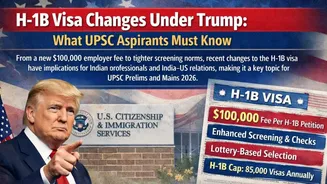
healthcare, finance). To be eligible for this coveted visa, applicants must have at least a bachelor’s degree or equivalent in a relevant field, and the US employer must file a petition on behalf of the candidate with the US Citizenship and Immigration Services (USCIS). This visa, which is one of the most popular visas among Indians, made headlines this year as the US President Donald Trump brought several key changes to this visa. It is important for UPSC Civil Services Prelims 2026 aspirants to know all about these changes and this visa, as changes to H-1B rules often feature in India-US bilateral relations, migration policy debates, and current affairs—making it important for UPSC Prelims and Mains. The H-1B visa has an annual cap of 85,000 visas (65,000 regular + 20,000 for US master’s degree holders). Since applications exceed the cap, selection is done through a lottery system. This visa is granted for three years initially, extendable up to six years. Further extensions are possible if the employee has applied for employment-based permanent residency. Interestingly, Indian professionals are the largest beneficiaries of the H-1B programme, especially in the IT sector. Since Donald Trump took control of the White House in January 2025, several changes were proposed and implemented for this visa. In September 2025, Trump issued a Presidential Proclamation requiring employers to pay a $100,000 fee for each new H-1B visa petition filed after September 21, 2025. This rule affects new applicants abroad and will be reviewed after one year. Following this, it was also announced that there will be enhanced screening for H-1B visa applicants, which may include checks of social media or background scrutiny, potentially lengthening processing times and adding scrutiny to eligibility. Due to this, there have been longer visa appointment wait times. This also affects dependents (e.g., H-4 visa holders).
Sample Questions For UPSC Prelims 2025
Prelims-type MCQs
- With reference to the H-1B visa, consider the following statements:
- It is a non-immigrant visa issued for specialty occupations.
- The visa is granted through a points-based selection system.
- Indian nationals form the largest group of H-1B beneficiaries.
(a) 1 and 3 only
(b) 2 and 3 only
(c) 1 only
(d) 1, 2 and 3 - The annual numerical cap on H-1B visas in the United States is:
(a) 50,000
(b) 65,000
(c) 85,000
(d) 100,000 - Which of the following recent policy trends has been associated with H-1B visa reforms in the US?
(a) Expansion of family-based immigration
(b) Prioritisation of higher wage and high-skill applicants
(c) Removal of employer sponsorship requirement
(d) Permanent residency at the time of entry
Mains-type Questions
- “Recent changes in the H-1B visa regime reflect a shift from quantity-based to quality-based labour migration.”
Discuss the statement in the context of India–US relations. (150 words) - Examine the impact of tightening H-1B visa norms on Indian professionals and India’s services sector. (250 words)
For feedback or story ideas, reach us at timesnoweducation@timesgroup.com