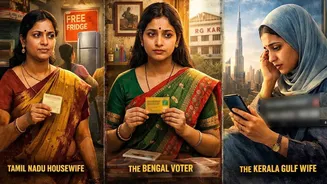





Forget the rallies. Forget the manifestos. Forget the exit polls. The 2026 state elections will be decided by ‘three women’, and those will never appear
on a TV panel. Why? Because one is standing in a ration shop queue in Madurai, wondering whether the free fridge promise is real or just another election season fairy tale. The second one is sitting in Barasat with a Lakshmir Bhandar card in her purse and the RG Kar nightmare in her head. The third one is in Malappuram, staring at a phone that hasn’t pinged with a money transfer in five weeks because her husband’s construction site in Dubai shut down when the Iran war started on February 28. These three women don’t know each other. They will never meet. But they will decide who governs 17.4 crore voters across Tamil Nadu, West Bengal, and Kerala. Because in all three states, women now make up nearly half the electorate. And every party knows it.
For the context: The assembly polls for Kerala, Assam, Tamil Nadu, Puducherry and West Bengal will commence from April 9. Polling in Assam, Kerala and Puducherry will be held on April 9 in a single phase. While in West Bengal, the first phase of voting is scheduled for April 23, followed by the second phase on April 29. Tamil Nadu will hold its elections on April 23 in a single phase.
Counting of votes for all five states and UTs is scheduled for May 4.
Coming back to the three women-in-question…
Woman 1: The Tamil Nadu Housewife
She doesn’t pay income tax. She runs the house. She is the target of the biggest welfare bidding war in Indian election history.
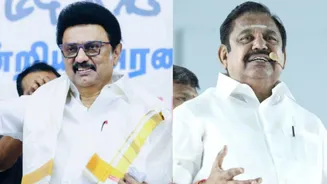
The DMK is offering her Rs. 8,000 in coupons to buy appliances: a washing machine, a fridge, a mixer, and an induction stove. Not a subsidy. A coupon. She gets to choose what she buys. The party already gives her Rs. 1,000 a month under the Magalir Urimai Thogai scheme.
The AIADMK is offering her Rs 2,000 a month, double of what the DMK is offering, and also a free fridge, three free LPG cylinders a year, and free bus travel for men in her family.
Both parties are essentially giving a message: we care for you, and we know your kitchen runs the house. Here’s money for the kitchen.
Tamil Nadu’s women voters are loyal to the issues and not one party. They swing. In one election they’ll back DMK. Next time, AIADMK. They evaluate, they compare, they switch. Oneindia’s data analysis found that Tamil Nadu women voters “do not remain loyal to one party” and “actively evaluate performance” before choosing. This isn’t a vote bank. It’s a jury. And both parties are trying to buy the jury with fridges.
Divya Krishnamurthy, 33, a private school teacher in Chennai, said, "They are giving me a fridge. I want a government job that pays me enough to buy my own fridge. There is a difference between a gift and a right."
"I voted DMK last time. I am listening to both sides this time. The coupon was useful. But my street still floods every monsoon. I have not decided yet," said Anitha Murugan, who works at a PR company in Chennai.
There’s a happy bunch too. Meenakshi Sundaram, a housewife in Madurai, said, "I bought a washing machine with the coupon. For the first time in 20 years I am not washing clothes by hand. You tell me that is not a change in my life."
Woman 2: The Bengal Voter
She is nearly 49% of West Bengal’s electorate, as per the latest ECI data. Over 3.44 crore women. The number of female voters in West Bengal, according to the February 28 draft published by the ECI following the SIR exercise, stands at 3.16 crore, compared to 3.76 crore in 2025.
Even then, SHE is the single most powerful voting bloc in the state.
West Bengal Chief Minister Mamata Banerjee built her entire fourth-term campaign around this woman. Lakshmir Bhandar (₹1,000/month to every woman head of household), Kanyashree (education support for girls), and Rupashree (marriage assistance). These schemes create a direct cash-to-vote pipeline that opposition parties in general and the BJP in particular could never replicate in Bengal.
But something is shifting. The RG Kar Medical College rape-murder case broke something. Women who were grateful for ₹1,000 a month are now asking: what’s the point of ₹1,000 if my daughter isn’t safe?
Times Now spoke to women in Kolkata, Bhabhanipur, and Barasat, who said that they don’t feel safe even in office space, let alone roads.
"Lakshmir Bhandar is 500 rupees. My daughter's school fees are 2,000. Tell me which problem it solves," said 34-year-old Piyali Das Barasat. “I can’t sleep until my daughter is back. What is Didi (Mamata Banerjee) doing for that?”
Priya Sarkar, 37, from Kolkata: "They think women only think about the kitchen. We think about our children's future. That is a bigger question than 500 rupees."
Then there’s Tiyasha Roy from Bhabhanipur. She said, “There are no good industries here. My husband and brother-in-law work in Bengaluru. Women are raising children alone. The government should create job opportunities.”
The SIR voter list crisis has worsened it. The female voter count dropped by almost 60 lakh in one year after the revision, according to data given by Union Law and Justice Minister Arjun Ram Meghwal in the Lok Sabha. The ruling Trinamool Congress alleges the deletions disproportionately targeted women — maiden names, marriage record gaps, and “logical discrepancies” that the party calls “nari-birodhi” (anti-women).
Woman 3: The Kerala Gulf Wife
SHE lives in Malappuram or Thrissur or Kozhikode. Her husband has been in Dubai or Riyadh or Doha for years. He sends money every month. School fees. EMI. LPG. Medicine. Everything runs on that money transfer.
Five weeks ago, the money slowed down or in some cases stopped. The Iran war shut the Strait of Hormuz. Oil is above $120. Construction projects across the Gulf are pausing. Tourism is down. Retail is shrinking. Her husband hasn’t lost his job — he’s just not getting shifts and there’s nothing back home.
According to the Centre for Development Studies' Kerala Migration Survey, approximately 2.1 to 2.5 million Keralites work in Gulf countries, remitting $23.4 billion in 2023 — a record figure and the financial backbone of the state's economy.
Naseema Kunhi, mother of two daughters, from Malappuram doesn’t know what’s next. "My husband called last week. He said the site is quiet, no new work is coming. I told him the school fees are due," she said, adding that “We are all waiting."
32-year-old nurse in Thrissur, Sheeba Thomas, says, "Pinarayi (Vijayan) condemned the war. Priyanka (Gandhi) condemned the war. (PM) Modi went to Israel before the bombs fell. I know all of this. But none of them can tell me when the money will come back to normal. That is the only question I have right now."
Fathima Shirin, a school teacher from Kozhikode said, "My brother-in-law is in Riyadh. My neighbour's husband is in Dubai. My cousin is in Doha. Every house on this street has someone in the Gulf. When they say the war is far away, I want to ask them — which street are they living on?"
SHE votes on April 9 — three days from now. And she doesn’t care about issues; she cares about her family, her husband, her son, her brother, and her relatives. And none have answers on this issue.
The Common Thread
Every party in every state is throwing money at women voters. Free fridges. Free coupons. Free bus rides. ₹1,000 a month. ₹2,000 a month. The offers keep getting bigger. But the THREE WOMEN at the centre of this election are not asking for appliances. They’re asking for safety, jobs, and a money transfer that arrives on time.
None of the manifestos in the three states convincingly address these issues.