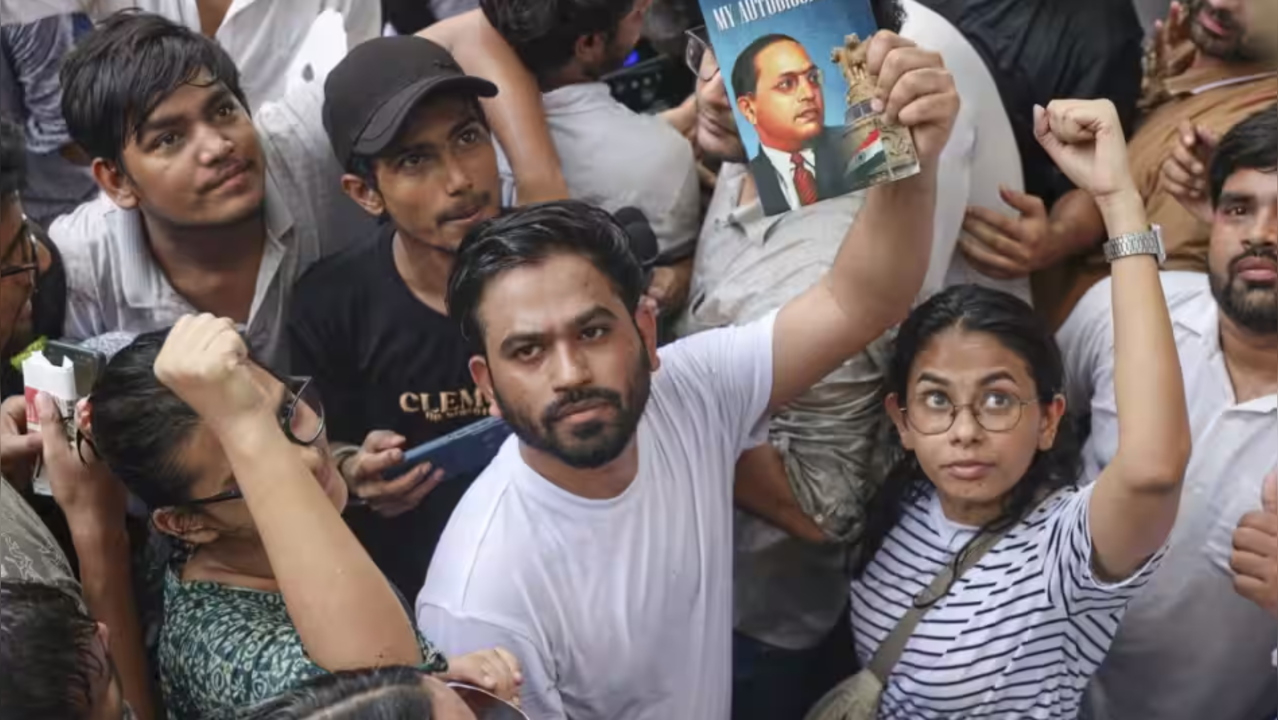






New Delhi: The Supreme Court on Monday (August 31) refused to restrain the Cockroach Janata Party (CJP) from staging a protest march from India Gate to Delhi Police
headquarters on September 5. However, the SC bench headed by Chief Justice of India (CJI) Surya Kant remained hopeful that everything behaves in a peaceful manner. The CJI said the proposed protest involved law-and-order and policy issues that should be addressed by the concerned agencies and stakeholders, adding that there was no compelling reason for judicial intervention at present. The CJI made these remarks as the top court was hearing a Public Interest Litigation (PIL) filed by retired Delhi Police officer Rajendra Singh, represented by advocate Rizwan Ahmed. The plea sought compensation for police personnel who were injured during the CJP protest at Jantar Mantar on July 20 and recovery of losses caused to government property from those allegedly responsible. The petitioner also sought a framework governing demonstrations near Parliament and other vital government institutions, including the creation of reasonable no-demonstration or protective zones. PIL seeks compensation for police personnel injured during the July 20 protest at Jantar Mantar, as well as recovery of loss to govt property from those responsible The petitioner further seeks a framework for demonstrations to be held near Parliament or other vital government institutions, including reasonable no-demonstration/protective zones. During the hearing, the petitioner’s counsel submitted that several aspects of the issue had not been addressed. The CJI, however, said the Supreme Court could not examine every aspect of the matter and referred the petitioner to the High-Power Committee constituted by the court to examine issues surrounding protests. “All aspects cannot be looked into by us. We won't comment on everything. Please go to the High-Power Committee we have formed,” the CJI said, adding that the committee would consider the issues one by one and submit its response to the court. The CJI described the committee as a “neutral umpire” and said stakeholders should deliberate on the broader policy and law-and-order questions. During the hearing, the court was informed that the CJP had announced a fresh protest march from India Gate to the Delhi Police Headquarters on September 5. Advocate Rizwan Ahmed drew the court’s attention to the upcoming BRICS summit scheduled for September 12 and 13. He argued that the proposed march should be postponed until after the summit, citing concerns over security and the presence of foreign dignitaries. “See, these are law-and-order issues. The decision has to be taken by law-and-order agencies,” the CJI observed. He further said that the issue also involved policy considerations and should be deliberated upon by the relevant stakeholders. The court expressed hope that all parties would maintain peace during the proposed demonstration. “As of now, there are no compelling circumstances for us to interfere,” the CJI said, adding that if any untoward or alarming incident occurred, the petitioner could approach the court with a fresh application. The Supreme Court said it would keep the matter for hearing along with the pending petitions concerning protests and related issues.