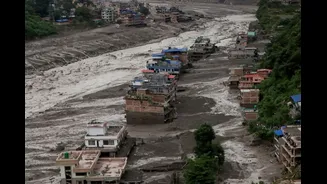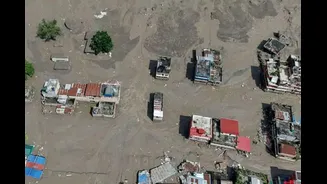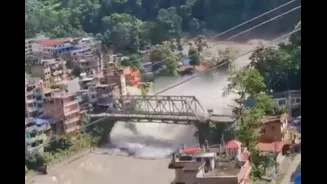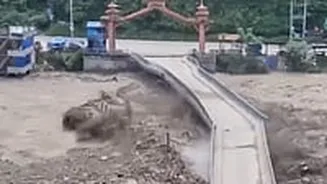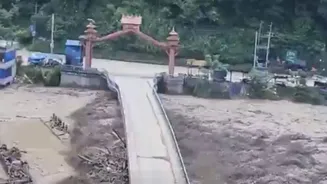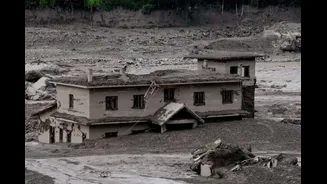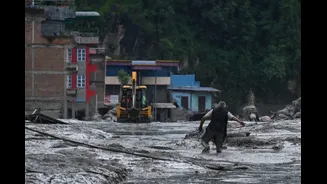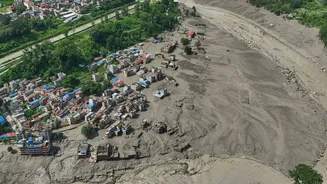






At least 157 people have been killed and hundreds remain missing after devastating flash floods swept through parts of Nepal, with Rasuwa, Dhading and Nuwakot
among the affected districts. The floods surged through the Bhote Koshi River after it crossed over from the Tibet side, leaving rescuers searching for survivors and bodies buried under the slush. According to Nepal's tourism board, 403 people were initially unaccounted for following the devastating floods, including more than 130 people from India and over 100 Nepali nationals. Among the missing foreign nationals were 33 Americans, 33 people from the UK, 34 Australians, 24 Canadians, 19 Malaysians, four Germans and one Israeli, the tourism board said. The disaster has also raised questions about why so many tourists and pilgrims were in the affected region. The answer lies in the area's important religious sites and pilgrimage routes, which attract thousands of visitors each year.
Sacred Sites Draw Thousands Of Tourists
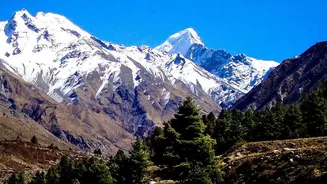
The flood-hit region is home to two high-altitude lakes revered by Hindus, Buddhists and Jains — Lake Mansarovar near Mount Kailash in Tibet and Gosaikunda Lake in Nepal's Rasuwa district.
Tens of thousands of tourists travel through Nepal to reach Lake Mansarovar annually. This period of the year is particularly popular, especially among Indian tourists, who also visit Gosaikunda to take a sacred dip.
Pradeep Pandit, managing director of Alpine Kailash Trek, told BBC that the route as hugely popular around this time of year, when visitors can see a full moon that is considered auspicious.
Mount Kailash, situated in Tibet, is revered by Hindus as the abode of Lord Shiva, while nearby Lake Mansarovar is also considered sacred. India's official Kailash Mansarovar Yatra portal describes the pilgrimage as having deep religious and cultural significance.
It is believed that completing the pilgrimage and taking a holy dip in Lake Mansarovar can cleanse a lifetime of sins and grant Moksha, or liberation from the cycle of rebirth.
What Caused The Devastating Floods?
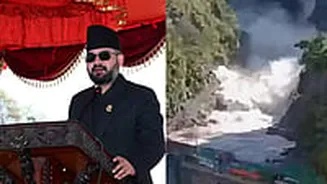
The precise chain of events behind the floods is still being investigated. Nepal's Foreign Minister Shishir Khanal told the country's House of Representatives that an earthquake at around 8:37 AM local time triggered a massive landslide that blocked the Bhote Koshi River, apparently causing the flooding.
The US Geological Survey reported a magnitude 4.4 seismic event along the Nepal-China border, north of Kathmandu, around the same time. An enormous mass of ice and rock is believed to have then moved down a mountainside into the Lhende Khola River, a tributary of the Bhote Koshi that flows from China into Nepal through steep mountain valleys.
However, scientists investigating the disaster are questioning whether an earthquake actually triggered the landslide. The USGS noted that a 5.2 seismic event near Kodari, Nepal, was caused by a landslide rather than an earthquake.
Daniel Shugar, a geologist at the University of California who is studying satellite imagery with a team of scientists, told CNN that the reported earthquake was probably seismic energy released by a landslide.
Researchers believe a large section of glacier may have broken away and fallen into the valley. A rock landslide could then have created a rapidly moving mixture of ice and rock, gathering more sediment and water as it traveled downstream during the monsoon season.
Shugar said it could take weeks to determine exactly what happened, noting that the enormous volumes of water visible in footage from the disaster remain difficult to reconcile with the current understanding of the event.