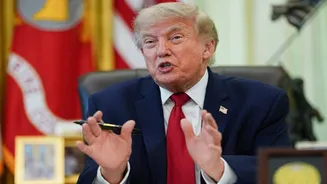




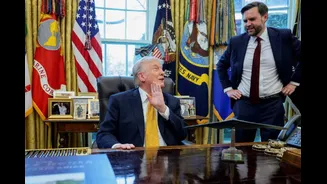


US President Donald Trump has again turned his fire on America's European NATO allies, questioning why Washington should continue carrying what he sees
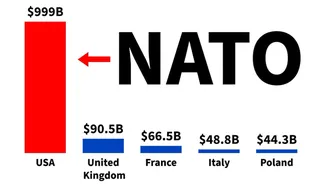
as a disproportionate share of the alliance's military burden when support is not returned during a crisis. His latest complaint came in a Truth Social post, where Trump pointed to the gap between US and European defence expenditure and singled out allies including the United Kingdom and France. “Ridiculous for the USA to continue along this one sided path when the relationship is not reciprocal. They were not there for us,” Trump wrote. In another emphatic line, the President added: “They were not there for us!!!” The intervention appears tied to Trump's frustration over the response of some European allies to the US war on Iran, particularly after Washington complained of restrictions involving bases, airspace and logistical support.
Trump Returns To NATO's Spending Divide
The figures cited by Trump appear to refer to the amount individual NATO countries spend on their own armed forces rather than direct payments into a common alliance fund. Al Jazeera compared the numbers used in his post with NATO's 2025 figures and found that, aside from relatively minor discrepancies, they broadly aligned.
But the numbers were only part of Trump's argument. The sharper charge was about reciprocity. His contention, repeated through the post, is that the United States continues to commit military resources on a scale far beyond its European partners while those same allies were unwilling to provide comparable support when American forces were engaged against Iran.
That dispute has already moved beyond presidential social media posts. On June 18, US Defense Secretary Pete Hegseth used a meeting of NATO defence ministers in Brussels to announce a six-month Pentagon review of American forces stationed across Europe. It is one of the clearest signs so far that Washington is taking a harder look at its military posture on the continent.
“This will be a real review,” Hegseth told allies. “It will be designed to ensure that NATO is moving fast and irreversibly toward Europe leading, stepping up to take primary responsibility for the defence of Europe.”
Iran War Exposed A Deeper Rift With European Allies
Hegseth was particularly critical of NATO countries that, according to Washington, refused access to bases, airspace or logistical facilities during recent American military operations against Iran. The Pentagon chief argued that those restrictions complicated US operations and exposed American personnel to risks that should not have existed between treaty allies.
“These allies put America's sons and daughters at risk by denying them the predictable access, basing and overflight that never should have been in question at all,” Hegseth said. His criticism echoed the complaint now being made by Trump more directly: when Washington sought operational support, some allies held back.
The row is awkwardly timed. NATO members have, in fact, increased military expenditure sharply as the security environment around Europe has deteriorated. Secretary-General Mark Rutte said European allies and Canada added roughly $90 billion in defence spending last year, a substantial rise from earlier levels.
Washington, however, is pressing for something beyond larger budgets. The Trump administration's public argument increasingly centres on whether European militaries can take primary responsibility for conventional defence of the continent, freeing American assets for other theatres.
The Indo-Pacific sits at the centre of that calculation. Earlier this month, the United States informed allies that assets traditionally assumed to be available during a major NATO crisis — including aircraft carriers, aerial refuelling aircraft and additional fighter squadrons — may no longer be automatically committed. American planners are increasingly weighing the possibility of simultaneous security emergencies in different regions, including a confrontation involving China.
There has also been movement on NATO's nuclear posture. The alliance's Nuclear Planning Group issued its first formal statement in 19 years following the Brussels meeting, reaffirming nuclear forces as the ultimate guarantee of NATO security. Ministers agreed to strengthen planning, modernise delivery systems and adapt the alliance's deterrence architecture.