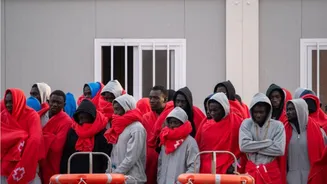







Nearly 2,000 migrants arrived in Spain's Canary Islands on Tuesday, November 24, setting a new single-day record for the Atlantic archipelago as migration
emerges as a major issue ahead of the country's national election later this week. Spain's maritime rescue service said 1,990 people reached the islands aboard 15 separate boats. Rescue vessels escorted the overcrowded boats into the small western island of El Hierro, which has become a key entry point for migrants attempting to reach Europe from West Africa. "Sadly, this is a historic day," Canary Islands regional leader Fernando Clavijo told Spanish radio station Cadena Ser. Around 100 minors were among those who arrived, including a four-day-old baby reportedly born during the dangerous sea crossing, Clavijo said. Senegal And Gambia Among Main Countries Of Origin According to Clavijo, most of the boats arriving on Tuesday originated from Senegal and Gambia. Favourable sailing conditions and a full moon were among the factors contributing to the surge in departures from West Africa. "The sailing conditions were favourable and there was a full moon, so these people looking for a better future ended up on our shores," he said. More than 26,000 migrants have reached the Canary Islands this year, with approximately half of them arriving in November alone. The previous single-day record was recorded on November 7, when around 1,400 people reached Gran Canaria. The Canary Islands, located off the northwest coast of Africa, have long served as a major migration route into Europe. Although the nearest African coastline is around 105 kilometres away, migrants frequently take longer routes to avoid security patrols. The Atlantic crossing is particularly dangerous, with journeys sometimes lasting several days or weeks. Boats can lose their way and drift into the open ocean, while thousands of people have died attempting the crossing over the years. Canary Islands Seek Help To Manage Migrant Influx Clavijo warned that El Hierro, which has a population of approximately 12,000, was struggling to accommodate such a large number of arrivals. Many migrants reached the island exhausted and in poor physical condition. He said he was broadly satisfied with arrangements to transfer adult migrants to mainland Spain but called on other Spanish regions to help accommodate unaccompanied minors requiring government care. Seasonal migration from West Africa often increases in November, before rougher winter conditions make the Atlantic crossing more dangerous. Relatively calm seas in recent weeks have also contributed to the increase in departures. Migration Emerges As Major Issue Ahead Of Spanish Election The record arrivals come ahead of Spain's national election scheduled for Sunday, November 29, with immigration expected to feature prominently in the campaign. The conservative Popular Party is seeking to unseat the ruling Socialist-led government. However, forming a government could require support from the far-right Vox party, which has campaigned on deporting migrants and prioritising Spaniards in social policies. Clavijo, who belongs to the regional Canary Coalition party, criticised political rhetoric targeting migrants, describing attempts to demonise them as "a xenophobic discourse of bad people". He also criticised a recent agreement involving Austria, Denmark, Germany, Greece and the Netherlands to send migrants to Rwanda, calling the proposal "ridiculous". "Europe is on the wrong path," Clavijo said.