







What is the story about?
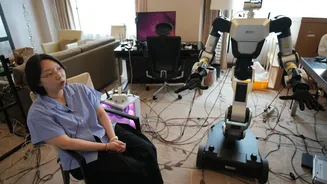
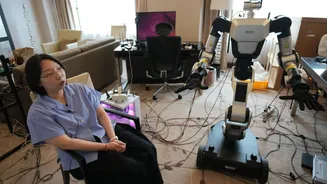
SEOUL, South Korea (AP) — David Park, a seasoned employee at the Lotte Hotel Seoul, is equipped with body cameras that record his movements as he folds
a banquet napkin. This meticulous process, which he has performed countless times in his nine years at the hotel, is part of an initiative to create a database aimed at teaching robots similar tasks. The South Korean startup RLWRLD collaborates with various companies, including the Lotte Hotel, to gather data from skilled workers across different industries. This effort seeks to build a comprehensive library of human expertise to develop AI systems capable of performing complex tasks in both industrial and domestic settings.
Data Collection from Various Industries
In addition to the hospitality sector, RLWRLD collects data from logistics workers at CJ, documenting how they handle goods in warehouses, and from employees at Lawson, a Japanese convenience store chain, to understand how they arrange food displays.The primary objective is to create an AI software layer that can operate across diverse work environments, with an emphasis on replicating the dexterity of human hands. The engineers at RLWRLD believe that developing humanoid robots will be pivotal in advancing the field of robotics.
South Korea's Focus on Physical AI
RLWRLD is part of a growing number of South Korean firms striving to excel in the competitive market for physical AI. This technology refers to machines that utilize AI and sensors to perceive, make decisions, and act autonomously in real-world environments, diverging from traditional robots designed for repetitive tasks.While the potential of these machines remains uncertain, they are integral to South Korea’s strategy to harness its strengths in semiconductor and manufacturing industries to establish itself as a leader in AI technology. The competition intensifies as U.S. companies like Tesla and numerous Chinese firms invest heavily in humanoid robotics.
Government Initiatives to Support AI Development
Recently, the South Korean government announced a $33 million initiative to capture the skills of master technicians for AI-enhanced manufacturing, aiming to improve productivity and address the challenges posed by an aging workforce.RLWRLD introduced its robotics foundation model, an AI system designed for industrial applications, with expectations for large-scale deployment by 2028. Major corporations, including Hyundai Motor and Samsung Electronics, plan to integrate humanoid robots and AI-driven processes into their manufacturing operations by 2030.
Concerns from Labor Groups
The push for robotics has raised concerns among labor organizations, who fear that increased automation could lead to job losses and undermine the skilled workforce that has historically given South Korea a competitive advantage. Following warnings from Hyundai’s union regarding potential employment disruptions, President Lee Jae Myung emphasized the need for adaptation to rapid technological changes.Kim Seok, policy director at the Korean Confederation of Trade Unions, highlighted the importance of continuous skill development and urged collaboration between the government, employers, and workers to address job security concerns amid the rise of AI technologies.
Training Robots on Human Behavior
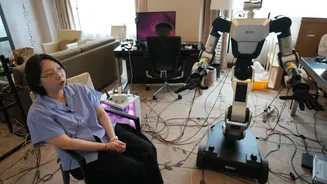
Humanoids from U.S. and Chinese companies have demonstrated impressive capabilities, but RLWRLD emphasizes that mastering delicate tasks will be crucial for their successful integration into various sectors. Hyemin Cho from RLWRLD stressed the significance of collecting motion data in real-world contexts.To enhance training, RLWRLD’s engineers convert worker footage into machine-readable data, adding layers of detail through repeated task simulations. This process captures intricate details such as joint angles and applied force, essential for developing robots that can perform complex tasks.
RLWRLD's lab, situated on the 34th floor of the Lotte Hotel, is equipped with advanced technology to facilitate this training. During demonstrations, robots have been observed performing tasks like carefully placing items, indicating progress in their development.
Future Prospects for Robotics in Hospitality
Despite the current limitations of humanoids in hospitality, Lotte Hotel anticipates that robots will be ready to assist with cleaning and other tasks by 2029. The hotel plans to offer rental services for robots, which could eventually extend to residential settings.Park noted that while robots may handle a significant portion of the workload in event preparations, the intricate nature of human interactions will still require a human touch. He estimated that humanoids could take over about 30% to 40% of back-of-house tasks, while the remainder would still depend on human workers.