








What is the story about?
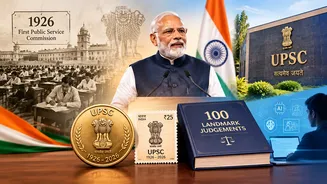
The Union Public Service Commission (UPSC) completed 100 years today, October 1, 2026, marking a century since the establishment of India’s first Public Service Commission.
It traces its origins to October 1, 1926, and has evolved from an advisory body into an independent constitutional authority. On this occasion, Prime Minister Narendra Modi addressed the UPSC centenary celebration at Bharat Mandapam in New Delhi today. At the event, a UPSC Centenary Commemorative Coin, a commemorative stamp and a book titled “100 Landmark Judgements – Shaping the Policies of UPSC and Public Service Commissions in India” will be released by the Prime Minister.
The two-day celebration began on September 30 with ‘Shatabdi Samaroh – Manthan'. In his speech, PM said that as the technology is evolving the coming era will being new challenges along with opportunities, such as deepfakes algorithmic bias and climate justice that future civil services aspirant may have to face.
Referring to the principle ‘Nagrik Devo Bhava’, he higlighted that citizens should be treated with highest priority and objective of the administration. He also noted two principles that should be kept in mind, ‘Nation First’ and then ‘Citizen First’, and that public services aspirants should understand their responsibility towards the nation and its citizens.
From Public Service Commission to Constitutional Body
Following Independence, the Federal Public Service Commission became the Union Public Service Commission on January 26, 1950, under the Constitution, with Shri R.N. Banerjee as Chairman. The All-India Services Act was enacted in 1951.
In 1976, the D.S. Kothari Committee proposed the three-staged examination, and in 1979 the three-stage Civil Services Examination, which includes Preliminary, Mains and Interview, was introduced.
The constitutional mandate of UPSC is contained in Articles 315 to 323. Under Article 320, its functions include conducting examinations for appointments to Union services and advising the government on recruitment, promotions and disciplinary matters.
At present, the UPSC conducts several major examinations, which include the Civil Services Examination, Indian Forest Service Examination, Engineering Services Examination, Combined Medical Services Examination, NDA & NA Examination, Combined Defence Services Examination and Central Armed Police Forces (Assistant Commandants) Examination.
UPSC and Its Roots in India
Its merit-based recruitment in India goes back to 1855, when the Indian Civil Service (ICS) examination was introduced through open competition, replacing the earlier system of nomination. The exam was conducted in Britain, and therefore, for an Indian to appear for the exam, they had to travel all the way to Britain.
The ICS exam included subjects such as Greek and Latin, as the British considered knowledge of classical European languages as an important part of the education of an individual. They favoured people who had received a British-style elite education.
This may appear as a merit-based recruitment on paper, but it reflected the British educational system and created major barriers for the Indians. By 1919, only 78 of the 1,255 ICS officers were Indian, according to the PIB press release.
The ICS exam was conducted in India for the first time in 1922 at Allahabad, alongside London, and in 1928 the Indian centre was moved to Delhi.
UPSC's Expanding Scale
The scale of UPSC's work has expanded significantly over the years. Applications across examinations and recruitment by selection increased from 42,727 in 1950-51 to 45,10,044 in 2022-23. The number of examination centres also increased from eight in 1950 to 86 in 2026.
The Commission has also witnessed greater participation from different sections of society. In the Civil Services Examination, the number of women recommended increased from three out of 83 candidates in 1952 to 299 out of 958 in 2025.
UPSC has continued to adopt technology in its recruitment process. Some of the crucial developments seen recently include the Universal Registration Number, randomised interview boards, AI-enabled facial authentication and the publication of the provisional Civil Services Preliminary Examination answer key in 2026.
As UPSC completes a century, its journey reflects the transformation of India's public recruitment system from its colonial-era beginnings to a constitutional, technology-enabled and increasingly inclusive institution.