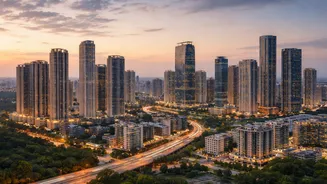










Hyderabad is no longer just about old bazaars, heritage buildings and sprawling neighbourhoods. Look up today, and the city tells a very different story.
From glass-clad towers to luxury homes soaring 40 and 50 floors high, Hyderabad has quietly transformed into India’s tallest city — rising faster and higher than Gurugram, Noida, Bengaluru, Pune and Kolkata, and signalling a new way Indian cities are choosing to grow. Over the past decade, Hyderabad has witnessed an unprecedented rise in high-rise residential and commercial towers, particularly along the IT corridor stretching from Gachibowli to Kokapet and Financial District. Liberal floor space index norms, faster approvals, large land parcels and sustained demand from IT professionals and investors have fuelled the growth. Luxury residential towers, many crossing 40 and even 50 floors, have become a defining feature of the city’s skyline. Unlike older metros, Hyderabad has expanded vertically without severe land fragmentation, allowing developers to build taller and denser clusters rather than scattered high-rises.
Gurugram and Noida: Height With Limits
In the National Capital Region, Gurugram and Noida are often associated with high-rise living. While both cities have several tall residential towers, growth has been constrained by regulatory bottlenecks, infrastructure pressure and uneven planning. Many projects remain isolated pockets rather than part of a continuous high-rise skyline, limiting their overall vertical scale compared to Hyderabad.🚨 Hyderabad has more skyscrapers than Gurugram, Noida, Bengaluru, Pune and Kolkata put together. 🤯 pic.twitter.com/zntNaAa5eq
— Indian Tech & Infra (@IndianTechGuide) January 28, 2026
India’s tech capital, Bengaluru, has largely grown outward rather than upward. Strict zoning rules, airport height restrictions and civic resistance to dense construction have kept most neighbourhoods mid-rise. While a few tall buildings exist along Outer Ring Road and Whitefield, the city’s skyline remains comparatively flat, spread wide instead of rising high.
Pune’s Cautious Climb
Pune has seen steady growth in high-rise housing, but its vertical expansion has been measured. Defence land, environmental norms and planning restrictions have capped building heights in large parts of the city. As a result, Pune’s skyline has evolved slowly, with fewer skyscrapers despite a booming IT and education-driven population.In Kolkata, heritage conservation, ageing infrastructure and cautious urban planning have limited vertical growth. While pockets like New Town and Rajarhat feature modern towers, the city’s historic core and strict regulations have prevented large-scale skyscraper development.
Why Hyderabad Stands Apart
Urban planners point to a rare combination working in Hyderabad’s favour:- Pro-growth policies and streamlined approvals
- Large, contiguous land parcels
- Strong demand from the IT and global services sector
- Modern infrastructure planned alongside new developments
The result is a city that has embraced vertical living at scale, reshaping not just its skyline but also how urban India imagines density and growth.