




Old Delhi is a place of food, fashion — more like first copies, but bride's favourite nevertheless — and ancient temples and Mughal monuments. But it is also
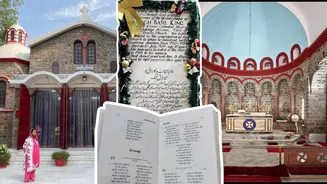
the place that arguably has Delhi's first Christian colony, where people offer Christmas service in Hindustani. While some of us are still recovering from the Diwali fever and preparing for the wedding season, the city is decking up for Christmas, and so is the Holy Trinity Church near Turkman Gate. Don't trust Google Maps if you have to reach there. On the maps, the church appears right opposite to the Turkman Gate police station, in reality, there is a narrow lane that many miss, which leads to a beautifully built Byzantine-style church of 1905. This is where you will hear people calling Christmas 'Eid'. Their carols are in Hindustani, and it won't take you long to just flip through a few pages of the hymn book and come across the hymn 'Eid-e-Tawallud'. This, along with the Central Baptist Church, are the only two churches that offer Christmas services in Hindustani in the capital. Jesus here is 'Ishu Massey', Holy spirit 'Pavitra aatma', and Godfather 'khuda baap'. Historian John CB Webster in Varieties of Dalit Christianity in North India, notes that the roots of this Church go back to Christian converts who came from Hindu lower-caste communities. The evangelist work of the Society for the Propagation of the Gospel played a big role. It is also not surprising to see Shahjahanabad (the name for Chandni Chowk and the Old Delhi area under Shah Jahan's rule) as a cultural hub, with traders across all religions interacting, often influencing one another. However, the Muslims were not very happy with it, since they were part of the ruling class, notes Moon Moon Jetley in her book, The Calm and Storm in Delhi: 1803-1857. Furthermore, everything that had earlier existed in Persian was being replaced by English. This resulted in an unamicable relationship, and as a result the Christian community of Shahjahanabad, was pushed back to the alleys of Turkman Gate, where they found a site for a sizable population to settle.
The Celebration of Eid-e-Tawallud
Here, the rum cake is substituted by Christmas 'pakwan', and a grand Mughal feast is prepared for lunch. Gujiyas, namakparas, shakkarparas, and bajre ki tikiyas are distributed, with people singing English hymns translated in Hindustani.
'Aaya Maryam ka beta, dekho teen raja purab disha se aaye hai unko taufa dene' (the son of Mary is here and three kings from the east have come to give his gifts), that is something you can hear if you attend the service on Christmas Eve.
The evening is then followed by a Christmas party, and some of the families there, in fact, host their own private gatherings. The menu is nothing less than a grand Mughal feast, with delicacies like biriyani, aloo gosht, nihari, korma, paaye, and kebabs. This is Old Delhi, a melting pot, really. Probably the only place where the celebration of Christmas is called Eid-e-wiladat (celebration of the birth or bara din).