







What is the story about?
A powerful El Nino event developing over the Pacific Ocean could become the strongest in living memory, with the UK Met Office warning that it could have
significant impacts on weather patterns around the world - including India. The Met Office has said the event is "very likely" to make 2027 the hottest year on record, surpassing the previous global temperature record set in 2024, a BBC report said. For India, one of the biggest concerns is the monsoon. El Nino events are generally associated with weaker southwest monsoon rainfall over South Asia. The Indian monsoon has already been running below normal in 2026, according to the Met Office.
What is El Nino?
El Nino is a naturally occurring climate pattern that develops every two to seven years and usually lasts about a year.
It occurs when trade winds over the Pacific weaken or reverse, allowing unusually warm water to move towards the eastern Pacific. This releases large amounts of heat into the atmosphere and can alter rainfall and temperature patterns across the world.
Scientists classify an El Nino when sea surface temperatures in a key region of the Pacific are at least 0.5°C above average. Current temperatures are already more than 2°C above normal.
Met Office forecasts suggest the anomaly could rise above 3°C later this year as the event reaches its peak. That would be unprecedented in records dating back to 1950 and could make it the strongest El Niño in more than a century.
"We should be clear that this is an unprecedented event," Prof Adam Scaife, head of long-range forecasting at the UK Met Office told BBC.
"I have never seen an El Nino signal this intense in our forecasts," he said.
Why India should be concerned
The most immediate concern for India is the southwest monsoon.
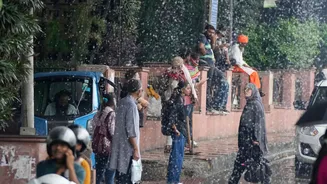
El Nino can disrupt atmospheric circulation and weaken monsoon rainfall over South Asia. Poor rainfall can have implications for agriculture, water availability, food prices and the broader economy, particularly if the effects persist into the following season.
The Met Office said there is already evidence that weather patterns are being affected, with the southwest monsoon in South Asia running well below normal so far in 2026.
However, scientists stress that no two El Nino events are identical, and the impact on India's monsoon can vary.
The developing El Nino could also influence weather elsewhere. Australia could face a higher risk of drought and bushfires, while Peru, Ecuador and parts of the southern United States could see increased flooding.
Could 2027 be the hottest year ever?
El Nino can temporarily push up global temperatures because heat stored in the Pacific Ocean is released into the atmosphere.
Met Office climate scientist Dr Nick Dunstone said this increase in global temperatures is particularly noticeable in the calendar year following the winter peak of an El Nino.
"Hence, 2027 is very likely to replace 2024 as the warmest year on record."
Scientists are closely watching the event because temperatures in parts of the Pacific's deeper ocean are already around 8°C above normal at a depth of about 100 metres.
Dr Zeke Hausfather, a climate scientist at Berkeley Earth, said this unusually warm water could provide a large reservoir of heat to strengthen the El Nino.
"We have many months to go while this event continues to develop and that's one of the reasons that we have increased confidence that this will be a record-setting event," Hausfather said.
Some climate groups have projected that temperatures could rise even further, potentially reaching 4°C above average in the key Pacific region.
If that happens, Hausfather said, "It's not beyond the realm of possibility to say this might be the strongest El Nino event in 500 or even 1,000 years," while stressing that such a long-term comparison cannot be confirmed with certainty.
The UN Food and Agriculture Organisation has also warned that El Nino could put tens of millions of people in vulnerable countries at risk of crisis-level food insecurity.
For India, the key question over the coming months will be how strongly the exceptional Pacific warming affects the monsoon and whether its consequences extend into agriculture, food prices and water availability.