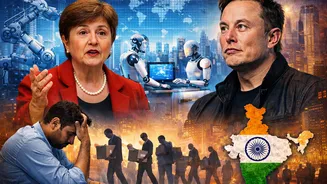

Artificial Intelligence (AI) is poised to reshape the global economy faster than any prior technological shift, with prominent voices like Elon Musk and
IMF Managing Director Kristalina Georgieva sounding alarms about widespread job disruption. Musk envisions a future where AI and robotics make most human work optional, while Georgieva describes an “AI tsunami” threatening entry-level roles and the middle class. Their views, grounded in rapid AI advancements, highlight risks of massive displacement—potentially affecting billions globally—particularly among middle- and lower-income workers in routine or cognitive tasks. Emerging economies like India face unique vulnerabilities, with millions of jobs reshaped or at risk by 2030. Elon Musk's Vision: Work Becomes Optional, Abundance Replaces Wages Elon Musk has consistently predicted that AI and robotics will eliminate the need for most human labor. In interviews from 2024–2026, he stated that “probably none of us will have a job” as AI outperforms humans in virtually every task. He projects this shift within 10–20 years (potentially by 2035–2045), with work turning into a “hobby” and money becoming “irrelevant” due to extreme abundance from automated production. Musk's rationale centers on exponential AI progress—generative models like those powering ChatGPT, combined with humanoid robots (such as Tesla’s Optimus)—handling physical and cognitive work at near-zero cost. This leads to a “universal high income” scenario, where goods, services, healthcare, and education become plentiful without traditional wages. However, he acknowledges risks: without jobs, humans may face a crisis of meaning, and the transition could be turbulent if not managed. While Musk does not pinpoint “by 2030” exactly, his timelines align with near-term breakthroughs, warning that billions could lose traditional employment as AI scales. IMF Chief Kristalina Georgieva: An “AI Tsunami” Hitting Jobs Worldwide Kristalina Georgieva has echoed concerns, describing AI as a “tsunami” disrupting labor markets faster than societies can adapt. At Davos in January 2026, she warned that AI threatens entry-level positions, making it harder for young workers (especially Gen Z) to enter the workforce and secure stable careers. IMF research shows AI exposing nearly 40% of global jobs—60% in advanced economies and 40% in emerging markets. Of these, roughly half could benefit from AI complementarity (boosting productivity), while the other half face automation of core tasks, leading to lower wages, reduced hiring, or outright displacement. In emerging markets, the risk leans toward replacement over enhancement due to limited infrastructure and skills. Georgieva emphasized impacts on the middle class and youth: entry-level clerical, marketing, and design roles are vanishing, stagnating wages and creating barriers to upward mobility. Why This Could Mean Billions Affected: Routine and Cognitive Tasks Targeted Both leaders point to AI's ability to automate routine cognitive work (data entry, analysis) and increasingly physical tasks (via robotics). Generative and agentic AI (autonomous systems) accelerate this, with models outperforming humans in many domains. Middle- and lower-class workers—often in clerical, administrative, manufacturing, or service roles—are most vulnerable, as AI displaces scalable, repetitive jobs without requiring high creativity or empathy initially. Globally, with roughly 3.5 billion workers, 40% exposure implies over 1.4 billion jobs affected. While not all will vanish, displacement could reach hundreds of millions to billions in extreme scenarios, per Musk’s and the IMF’s estimates. How AI Will Affect India: High Exposure, Millions at Risk As an emerging market, India faces roughly 40% job exposure, similar to IMF averages. Sectors like IT-BPO, customer service, manufacturing, and administrative roles—core to middle- and lower-class employment—are highly automatable. Entry-level positions in tech and services could shrink, exacerbating youth unemployment and inequality. Estimates vary. Agentic AI could reshape over 10 million jobs by 2030, said a TOI report last year. NITI Aayog has warned of up to 2 million losses in the tech sector alone. Some reports cite up to 38 million jobs at risk by 2030, while AI could also create around 4 million new jobs in tech and related fields. Lower-skilled workers may face wage stagnation or job loss, widening inequality. Skill gaps in AI, IT, and creative fields hinder complementarity, leaving many unable to transition. India, with its massive young workforce and service-led economy, stands at the epicenter of AI's global disruption. Recent analyses paint a picture of both significant risks and opportunities. While estimates suggest that only about 7% of jobs in India and South Asia are at “high risk” of outright displacement due to low complementarity with AI, the broader impact is far-reaching. Generative AI and agentic systems are expected to transform or reshape up to 38 million jobs by 2030, primarily in the organized sector. This transformation focuses on productivity gains, but it also signals major shifts in how work is performed—many roles will evolve, some will diminish, and new ones will emerge. The phrase “vanish” often appears in headlines, but credible sources emphasize transformation over total elimination. Jobs will not disappear en masse overnight. Instead, AI will automate routine tasks, reduce demand for certain skills, and create demand for others. Middle- and lower-class workers in repetitive or data-heavy roles face the greatest exposure, while those who adapt through upskilling could thrive. High-Risk Sectors and Job Numbers at Stake Vulnerable sectors are those reliant on routine cognitive work, customer interaction, or basic processing—areas where AI chatbots, coding assistants, and automation tools already excel.
- Manufacturing leads the pack, with around 80 lakh (8 million) jobs at risk. AI-driven robotics, predictive maintenance, and quality control systems are automating assembly lines and repetitive manual tasks.
- Retail faces exposure of approximately 76 lakh (7.6 million) jobs. Inventory management, cashier roles, personalized recommendations, and supply chain optimization are increasingly handled by AI, reducing the need for traditional staff.
- Education has about 25 lakh (2.5 million) jobs considered vulnerable. AI tutors, automated grading, and personalized learning platforms are reshaping teaching and administrative roles, especially entry-level ones.
- Business Process Outsourcing (BPO) and customer service—cornerstones of India’s IT-enabled services—are under pressure as AI chatbots and voice agents handle routine queries. Reports indicate that up to 81% of tasks in counter and rental clerk roles could be automated.
- Information Technology (IT) is seeing pressure on entry-level programming and coding jobs from tools that automate writing, editing, and debugging code. Even senior roles face significant task automation.
- Human Resources (HR) is being reshaped as resume screening, onboarding, and scheduling are replaced by AI agents, with multinational companies already downsizing teams.
Finance and banking are also affected, with loan processing, fraud detection, and basic analysis increasingly automated and, in many cases, outperforming human speed and accuracy.
These sectors are concentrated in tech hubs such as Bengaluru, Hyderabad, Chennai, and Pune, where companies are rapidly adopting AI for round-the-clock efficiency without human overheads. White-collar job postings have shifted sharply—AI-related roles have more than doubled, while traditional postings in vulnerable areas have shrunk significantly.
Why Middle- and Lower-Class Workers Are Hit Hardest
India’s workforce includes millions in middle- and lower-income brackets performing routine or semi-skilled tasks—precisely the areas AI targets first. Without reskilling, this could lead to wage stagnation, reduced hiring, and higher youth unemployment. While most jobs show complementarity where AI boosts productivity, the smaller share at high risk is concentrated in lower-wage segments. Geographic concentration in urban tech corridors further amplifies the issue, potentially widening urban-rural and skill divides.
Opportunities: The “Golden Seven” AI-Proof and Emerging Career Paths
The disruption is not entirely negative. AI is also creating large opportunities in human–AI collaboration. Projections point to net job growth in several areas, with new roles emerging rapidly.
- AI-Human Collaboration Roles — Positions requiring emotional intelligence, creativity, and complex decision-making remain irreplaceable. Healthcare roles like nurse practitioners are projected to grow rapidly (up to 45% in similar global trends).
- Education Technology Integration — "AI for Teachers" roles have seen explosive growth (up to 7,600% in demand), focusing on blending AI tools with human pedagogy.
- Cybersecurity and Ethical AI — As AI proliferates, specialists in protecting systems and ensuring ethical use are in high demand.
- Creative and Content Strategy — AI generates content, but human insight into culture, emotion, and nuance drives value—professionals who collaborate with AI tools thrive.
- Healthcare and Mental Wellness — The human element in therapy, counseling, and patient care is enduring, fueled by growing mental health awareness.
- Sustainability and Green Technology — India's net-zero goals and $125 billion green investments create demand for environmental and renewable energy experts.
- Data Strategy and AI Implementation — The biggest opportunity: experts who integrate AI into business workflows, identify use cases, and drive productivity gains.
Together, these paths highlight the importance of upskilling in AI literacy, creativity, ethics, and domain expertise to navigate India’s AI-driven transition.
Disruption vs Opportunity
Musk and Georgieva agree AI will profoundly alter work—potentially making it optional in an era of abundance or causing painful displacement during transition. Middle- and lower-class workers, especially in routine roles, bear the brunt.
For India, with its young workforce and service-driven economy, the stakes are high: millions could be reshaped or lost by 2030 without proactive reskilling, education reform, and social protections.
Policies such as lifelong learning, AI-inclusive training, and robust safety nets could mitigate risks and harness benefits. As Georgieva urges, “Wake up. AI is for real”—preparation today will determine whether this transformation reduces hardship or deepens inequality.