






What is the story about?
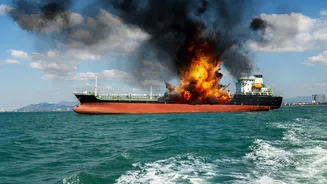
Tehran: Five Indian seafarers aboard a Kuwait-flagged tanker were rescued and shifted ashore after their vessel was struck by a projectile in the Strait
of Hormuz. The development was confirmed by the Embassy of India in Oman. In a post on X, the embassy said it coordinated the rescue operation. The Embassy also thanked Omani authorities for their continued cooperation and support throughout the rescue operation. “Earlier today, the Mission coordinated rescue of five Indian nationals on board the Kuwait-flagged tanker MT Kazimah III, struck by a projectile in the Strait of Hormuz. All 5 Indian nationals have been shifted ashore safely. We thank the Omani authorities for their continued support and assistance,” the Embassy said in the post.
The vessel is a crude oil tanker. It was sailing under the flag of Kuwait and was en route to the port of Lomé in Togo. The development comes amid India’s continued efforts to closely track the safety and welfare of Indian seafarers working aboard commercial vessels in the Persian Gulf.
Ministry of External Affairs spokesperson Randhir Jaiswal had said on Tuesday that more than 4,500 Indian seafarers are currently on board various commercial vessels operating in the area, including 163 Indian seafarers on 12 active cargo ships.
“At this point, we have six India-flagged commercial vessels in the Persian Gulf. We also have six foreign-flagged vessels which are carrying cargo to India. So 12 ships are there. On these ships, we have around 163 Indian seafarers who are on board,” Jaiswal had stated during a media briefing.
“Apart from this, we also have over 4,500 Indian seafarers who are on board various commercial vessels which are operating in the area,” he had added.
Jaiswal had said the Ministry of Shipping, in coordination with Indian diplomatic missions and local stakeholders, was monitoring the movement of vessels and the well-being of Indian seafarers.
“Our Ministry of Shipping continues to monitor the movement of these ships and is looking at the well-being of all these seafarers, and as and when required, through our embassies and other stakeholders, they do the needful for their well-being and welfare,” he had stated.
“On our side, we remain committed to the safety and well-being of our seafaring community abroad,” Jaiswal had said.
Iran's 7-Day Peace Proposal, Rejection By The US
Last month, Iran had proposed a seven-day roadmap to end the conflict with the United States, but the Strait of Hormuz would remain closed for most of the proposed truce. Under Tehran's plan, the crucial shipping passage would reopen only on the sixth day, with broader nuclear negotiations with Washington beginning on the seventh.Iranian Foreign Minister Abbas Araghchi had said Tehran would open the strait after the United States ended the conflict, lifted its blockade, released Iranian frozen assets and allowed Iran to resume oil sales.
However, the US had rejected the proposal, objecting to Tehran's demand that sanctions relief, access to frozen Iranian assets and other economic measures be provided at the outset.
Daily vessel traffic through the Strait of Hormuz dropped significantly following the outbreak of the US-Iran war on February 28. Notably, the strait, a key waterway, accounted for 20 per cent of the world's crude oil and liquefied natural gas before the start of the war.