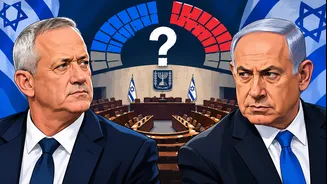






The 2026 Israel Parliamentary Elections are staring at a deadlock, with no clear winner in sight. But what happens if the result does indeed lead to a hung
Knesset? If no single alliance or party secures the required 61 seats for majority in the 120-member Knesset, the country then is set to enter a coalition-building process. Once the election results are finalised, the President of the country- in this case Isaac Herzog- consults representatives of the elected parties to determine who has the best chance of forming a coalition government. The incumbent prime minister generally remains in office in a caretaker capacity until a new government is formed. The president then tasks a member of the Knesset with forming a government. The nominee need not belong to the largest party but must have a reasonable prospect of securing parliamentary support.
What Happens Next?
The nominee then has 28 days to negotiate a coalition and form a government. The president can grant an extension of up to 14 days. If the candidate fails to form a government, declines the mandate or returns it, the process moves to the next stage, where the president can then assign the task to another Knesset member, who gets 28 days to form a government, without an extension under this route.What Happens If All Attempts Fail?
If this attempt also fails, at least 61 Knesset members can jointly ask the president to nominate another candidate. The proposed candidate must agree to take on the task and is given 14 days to form a government.
If the coalition-building process fails, the Knesset can be dissolved under the applicable legal procedures, paving the way for fresh elections.
Options For A Govt
The Parties can explore several arrangements to reach or sustain a parliamentary majority:
- Coalition government: Two or more parties join forces to cross the 61-seat threshold.
- Unity government: Rival political blocs agree to share power, potentially through a rotation agreement.
- Minority government: A party or bloc governs without 61 seats of its own, relying on outside support or abstentions to survive confidence votes.