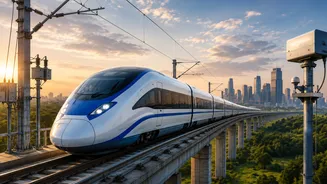








The Mumbai-Ahmedabad High-Speed Rail (MAHSR) project has entered a crucial phase with electrification work gathering speed. India's first bullet train
corridor will feature a world-class 2×25 kV traction system, earthquake detection technology and a strong 'Make in India' component. Electrification work on the 508-km Mumbai-Ahmedabad Bullet Train corridor is progressing rapidly alongside civil construction and track laying, marking another major milestone in India's first high-speed rail project. For the first time in the country, the corridor is being equipped with an advanced 2×25 kV Overhead Traction System, one of the world's most sophisticated railway electrification technologies. The system has been designed to provide a stable and uninterrupted power supply for trains operating at speeds of up to 320 kmph. Power will be supplied from the National Grid to specially designed Grid Substations and then distributed through 14 Traction Substations located along the route. Of these, five are in Maharashtra at Mumbai, Thane, Virar, Boisar and Thane Depot, while nine are in Gujarat at Vapi, Bilimora, Surat, Bharuch, Vadodara, Anand, Mahemdabad, Ahmedabad and Sabarmati Depot. To ensure uninterrupted operations, the corridor will also have 31 Switching Posts, allowing seamless power transition as trains move from one section to another and enabling quick isolation of faults whenever required. In addition, 16 Distribution Substations are being constructed to supply electricity to stations, signalling systems, maintenance depots and other operational infrastructure.
22,000 Steel Masts to Support High-Speed Network
The overhead electrification system will be supported by nearly 22,000 steel masts and more than 25,700 cantilever assemblies spread across 1,125 track kilometres, including depots.
Standing between 10.5 and 14.5 metres high, these structures will support an advanced compound catenary system, another technology being introduced in India for the first time. Every overhead wire will be installed under precisely calculated mechanical tension to ensure smooth, uninterrupted power collection by the train's pantograph even at speeds of 320 kmph.
Major Push for 'Make in India'
A significant portion of the high-speed electrification infrastructure is now being manufactured domestically under the 'Make in India' initiative.
Key components including transformers, cross arms, ground wires, protection wires, feeder wires and several traction power supply and electro-mechanical systems are being produced in India. Officials said this represents a major transfer of advanced high-speed rail technology, strengthening domestic manufacturing capabilities, creating specialised jobs and reducing dependence on imports.
Earthquake Detection System for Passenger Safety
Safety has been integrated into the project through an Early Earthquake Detection System.
Each of the 14 traction substations will be equipped with seismometers capable of detecting seismic activity within seconds and automatically triggering protective measures to stop trains during an earthquake.
A total of 28 seismometers will be installed, including 22 along the bullet train corridor and six inland stations in earthquake-prone regions of Maharashtra and Gujarat. Gujarat will have 16 seismometers installed at locations including Vapi, Bilimora, Surat, Bharuch, Vadodara, Anand, Mahemdabad, Ahmedabad, Adesar and Old Bhuj.
Real-Time Monitoring
The entire electrical network will be monitored through a centralised control centre, with automated protection systems capable of responding within fractions of a second to ensure safe, reliable and uninterrupted operation of India's first bullet train corridor.
The electrification work marks another significant step towards commissioning the Mumbai-Ahmedabad High-Speed Rail project, which is expected to transform long-distance rail travel in India with world-class technology and speeds of up to 320 kmph.