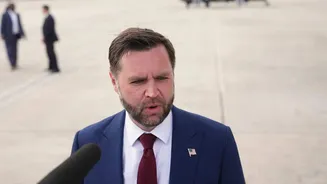









The White House has rejected a report claiming that senior officials advised Vice-President JD Vance to reduce his activity on social media, describing
the allegation as "complete fake news". The claim, published by The New York Times, said White House Chief of Staff Susie Wiles and other senior aides had encouraged Vance to "take a break from social media", arguing that his frequent online exchanges with critics were "beneath his office". Responding on X, White House Communications Director Steven Cheung said the report was inaccurate. "This isn't true," Cheung wrote. "We denied it to the New York Times and they refused to run our quote. Complete fake news. This supposed 'conversation' never happened." The allegation appeared in a wider article examining Vance's relationship with President Donald Trump and his potential prospects in the 2028 Republican presidential nomination race. The Times article did include comments from Cheung defending the vice-president's role within the administration. "Vice President Vance has done a remarkable job of helping implement the president's America First agenda," he told the newspaper. "Any false media narratives from unknown and unnamed sources fabricating stories clearly do not have any knowledge of the truth." Trump adviser Alex Bruesewitz also criticised the report, accusing its authors of what he described as "Vance Derangement Syndrome". "Steven Cheung has stated clearly in the article and reiterated on X that this is completely fake news," Bruesewitz wrote. "JD Vance is an exceptionally effective communicator and invaluable member of President Trump's Team. Vance Derangement Syndrome is real, folks." Vance is widely regarded as a potential contender for the Republican presidential nomination in 2028, when Trump will be unable to seek another term under constitutional term limits. Secretary of State Marco Rubio has also emerged as an early prospective candidate. Recent polling on a hypothetical Republican primary contest has shown the two administration figures running closely, as discussion continues over who could lead the party in the post-Trump era.