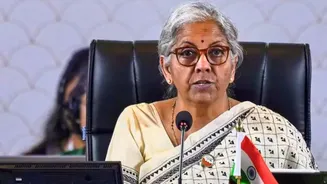










India's expanding middle class is set to play an even bigger role in shaping the country's economic future, Finance Minister Nirmala Sitharaman said while
addressing an international economic forum in France. Speaking at the Rencontres Economiques d'Aix-en-Provence during a panel discussion on 'How to promote the rise of a new middle class', Sitharaman highlighted the growing influence of middle-income households on consumption, investment and regional development. According to the finance minister, the middle class now accounts for 31 per cent of India's population and has continued to expand steadily since the country's economic liberalisation, recording an annual growth rate of 6.3 per cent. Sitharaman said rising consumer spending from middle-income households is becoming the backbone of India's economic momentum. She pointed out that purchasing power is no longer concentrated in the country's largest metropolitan areas but is spreading across smaller urban centres. "We think 93 per cent of all spending in India will be because of the middle class or the slightly affluent consumers...and again, this middle class is not concentrated in our metropolitan cities...India's model has resulted in the development in such a way that the middle class is present not just in big cities but they are on the contrary in these tier two, tier three cities," She added that this broader geographic spread of income is helping create more balanced economic development. "So, we see the middle class not just as a beneficiary of growth, but actually as the engines of growth. It is their consumption, which is happening, which is making the economy grow," she said. Nearly 500 Cities Set to Become New Economic Hubs Referring to long-term economic trends, Sitharaman cited findings from an OECD study suggesting that India is on course to overtake China in terms of middle-class population between 2030 and 2035. She said India's post-pandemic economic resilience has been driven largely by domestic consumption. "Nearly 500 cities poised to emerge as the new centres of economic activity," FinMin added. The minister also outlined several government measures aimed at expanding the middle class, including financial inclusion initiatives, GST rate rationalisation, collateral-free lending schemes and the Pradhan Mantri Awas Yojana. Addressing concerns around artificial intelligence, Sitharaman said the government is investing in programmes designed to equip citizens with future-ready skills. AI-focused training camps are being organised across districts in collaboration with private companies, enabling workers to adapt to technological change. She noted that these initiatives are helping more people access opportunities created by India's digital economy. Sitharaman also highlighted the growing role of micro, small and medium enterprises (MSMEs), stating that they now contribute nearly 40 per cent of India's exports. Many of these businesses are increasingly integrating AI into their operations and seeking professionals with expertise in AI-based solutions. The finance minister further said India has become a preferred destination for Global Capability Centres (GCCs) and data centres. She attributed this to the country's expanding pool of skilled professionals, which continues to attract global companies looking to accelerate AI adoption and digital transformation. (With PTI inputs)