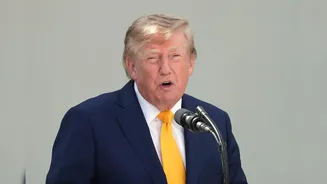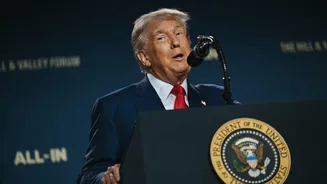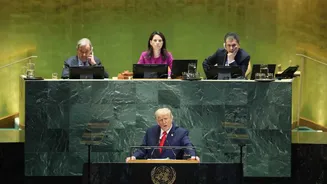




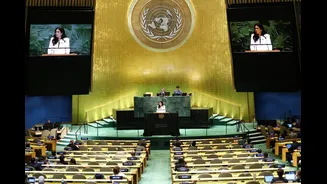
US President Donald Trump turned his attention to artificial intelligence during his address to the United Nations General Assembly, describing the technology
in highly positive terms and suggesting that “artificial intelligence” could be given a new name. Speaking at the UNGA, Trump said the term “artificial” did not accurately reflect the capabilities of the technology. He suggested that US government documents, and potentially documents around the world, could eventually use the word “super” instead. “From this point forward, all United States documents, and hopefully the world’s, will be changed to use the much more accurate term: ‘super,’ as opposed to ‘artificial’,” Trump said. Trump Proposes ‘Superintelligence’ Trump then suggested the term “superintelligence”, abbreviated as “SI”, as an alternative to artificial intelligence. “In other words, welcome to the new world of superintelligence — SI,” Trump said. He appeared to suggest that the new terminology would better capture the capabilities of AI and the direction in which the technology is developing. “Let’s see if that goes. It sounds much better,” Trump added. Trump also described AI as “amazing” during his remarks, reflecting the increasingly prominent role the technology has taken in government, business and everyday life. The comments came as governments around the world continue to debate how AI should be developed and regulated. The technology has rapidly expanded into areas including search, software development, healthcare, finance, education and content creation. AI And The ‘Super’ Debate Trump’s comments focused on terminology rather than announcing a specific change to US AI policy. His suggestion to use “superintelligence” would represent a shift in language if adopted across official documents. The term “superintelligence” is also used in technology and academic discussions to describe AI systems that could potentially exceed human capabilities across a broad range of intellectual tasks. It is therefore distinct from the broader term “artificial intelligence”, which covers existing AI systems and technologies. Trump’s UNGA remarks nevertheless put a spotlight on the language being used to describe the rapidly developing technology. By proposing “superintelligence — SI”, Trump indicated that he sees the capabilities of AI as extending beyond what the word “artificial” may suggest. His remarks also come as the US and other governments seek to shape international discussions around AI development, safety, innovation and regulation.