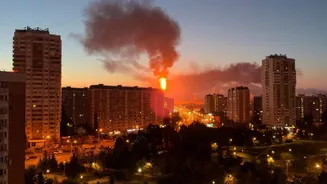





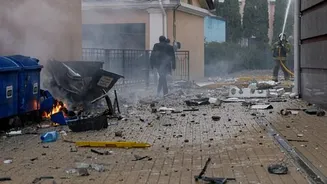
Ukraine is hitting Russian targets farther from its borders and more often than before. In the past 50 days alone, 40 Russian oil and military-industrial
sites have been struck, and the campaign has now reached as far as the Mediterranean. The strikes have covered a fuel terminal on the Arctic White Sea and a missile-propellant plant deep in Siberia. A Russian military cargo ship was set on fire in the Baltic Sea, and a warship was sunk off the coast of Libya. A section of roadway on Russia's bridge to occupied Crimea also fell into the sea after a blast. The campaign now stretches more than 1,500 miles and takes in at least five seas. Its aim is to cut the networks that keep Moscow's war machine supplied with fuel, weapons and money. In the process, Kyiv is turning Russia's huge size and widely spread assets into a weakness.
Russia still has the edge in long-range power
Russia remains stronger in long-range strikes. It can hit any part of Ukraine with ballistic missiles, and Kyiv has little defence against them without more US-made interceptors. Moscow also has more troops and weapons, and it is betting it can outlast Ukraine.Heading into winter, Russia is going after power plants, heating networks and railways. The goal is to hurt Ukrainian civilians and push Kyiv toward surrender.
Ukraine's response
Ukraine has its own tools, and it is using them at a record pace. On some days its forces have sent more than 1,000 drones into Russia. Kyiv has kept hitting Russian refineries, pushing output to a two-decade low, even though President Trump told asked Kyiv to stop.Elbridge Colby, the US under secretary of defense, criticised Ukraine earlier this month over what he called "the spectacle of deep strikes." He said they "have not been effective in driving an end to the war."
Kyrylo Budanov, who heads the Ukrainian presidential office, admitted that "long-range strikes alone will not win the war." Even so, he argued that each hit brings repairs, lost output, logistics changes and extra costs, which makes it harder for Russia to keep fighting. The strikes also force Moscow to pull air-defence systems away from the front line and move naval assets to guard ships at sea.
Strikes in the Baltic and the Mediterranean
The reach of the campaign was clear this past week. Ukrainian drones hit a Russian military cargo ship, the Sparta II, in the Gulf of Finland in the eastern Baltic. The following morning, seven naval drones got through defensive fire at the Libyan port of Benghazi, more than 1,000 miles from Ukraine.The swarm sank the Merkury, one of Russia's newest warships, together with a combat helicopter on board. It also hit a Russian cargo ship that President Volodymyr Zelensky said was carrying weapons.
Officials in the government that controls eastern Libya promised to retaliate. Zelensky has defended hitting Russian targets anywhere in the world as a sovereign right to self-defence, and called the strikes "our long-term security guarantee."
Allies are more cautious
European allies have defended Ukraine's strikes inside Russia. Their first reaction to attacks in the Baltic and Mediterranean has been more guarded. Some worry Russia could treat such strikes as an escalation, a point Colby also made.Italian Prime Minister Giorgia Meloni said the war "should not and cannot be extended to the Mediterranean." Zelensky said he then phoned her and confirmed that the attack "was conducted without prior coordination with our European partners."
Both sides are fighting beyond their borders
Russia is also widening the conflict. It is running a shadow war of arson, sabotage and assassination plots across Europe, has entered NATO airspace, and has attacked ships in the territorial waters of NATO countries. Ukraine, for its part, is searching far and wide for Russian military assets to weaken Moscow's ability to project power.According to the New York Times, the pace and range of Ukraine's attacks are still growing.