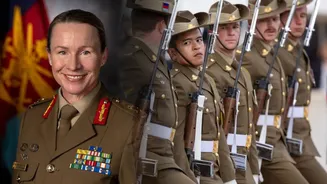







Australia is set to mark a historic milestone as Lieutenant General Susan Coyle becomes the first woman to serve as Chief of the Australian Army. Prime
Minister Anthony Albanese confirmed the appointment, noting that it represents the first time in the army’s 125-year history that a woman will hold the top position. Coyle will assume command in July 2026, succeeding Simon Stuart at a time when Australia is recalibrating its military posture amid evolving regional threats.
There is no higher honour than serving our country.
— Anthony Albanese (@AlboMP) April 13, 2026
Today we’re announcing new leadership across the Australian Defence Force.
We thank Admiral David Johnston and Lieutenant General Simon Stuart for their decades of service and leadership.
All Australians owe a debt to those… pic.twitter.com/1bOnK5n5NY
A 30-Year Career Across Combat And Command Roles
Susan Coyle brings more than three decades of military experience to the role, having enlisted in the Army Reserve in 1987 before graduating from the Royal Military College in 1992.
She began her career in the Royal Australian Corps of Signals, a background that would later shape her expertise in modern warfare domains.
Over the years, she has held a series of critical command roles, including Commander Forces Command, Commander Joint Task Force 633, and Commander of the 6th Brigade. Her operational experience spans deployments in the Solomon Islands, Timor-Leste, Afghanistan, and West Asia.
Cyber And Space Expertise Signals Strategic Shift
Currently serving as Chief of Joint Capabilities and overseeing space and cyber domains, Coyle’s appointment reflects a clear strategic pivot within the Australian Defence Force.
Her background in information warfare and emerging domains highlights the increasing importance of cyber operations, space capabilities, and network-centric warfare in modern military doctrine.
Defence experts view her elevation as part of a broader transformation, with Australia investing in long-range strike systems, drones, and advanced technologies to enhance combat readiness.
Representation And Reform In Focus
The appointment also carries symbolic and institutional significance.
Defence Minister Richard Marles described it as a “deeply historic moment,” emphasising its impact on gender representation within the armed forces.
Currently, women make up around 21% of the Australian Defence Force and approximately 18.5% of senior leadership. The ADF has set a target of increasing female participation to 25% by 2030.
Coyle herself underscored the importance of visibility in leadership, noting that representation can shape future generations of service members.
Leadership Transition Amid Broader Challenges
Coyle takes charge at a time when the Australian military is undergoing significant structural and cultural changes. Beyond modernisation efforts, the armed forces have faced scrutiny over internal issues, including allegations related to the treatment of female personnel.
Her leadership is expected to play a role not only in operational transformation but also in addressing institutional challenges. Globally, her appointment places Australia among a small group of nations that have elevated women to top military leadership roles, signalling a gradual but notable shift in defence leadership structures.