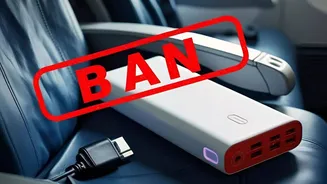









Aviation regulator has issued a detailed safety advisory to airlines and airport operators to minimise the risk posed by lithium batteries carried by passengers
and crew, citing a rise in fire-related incidents globally linked to such devices. The Directorate General of Civil Aviation (DGCA) said lithium batteries, commonly used in power banks, mobile phones, laptops and tablets, pose a serious onboard fire hazard due to their high energy density and potential for “thermal runaway”. “Power banks, portable chargers, and similar devices containing lithium batteries can act as ignition sources and potentially initiate on-board fires,” the advisory said, warning that devices kept in overhead bins or inside cabin baggage may delay detection of smoke or fire.
The DGCA noted that lithium battery fires are “very energetic” and may lead to explosions. Such fires can be triggered by overheating, overcharging, crushing, internal short circuits, poor manufacturing quality, ageing or mishandling. Unlike conventional fires, lithium battery fires can be self-sustaining and require specialised firefighting methods, it added.
The advisory said it was issued after “numerous safety occurrences globally where the suspected cause was attributed to lithium batteries carried aboard aircraft”.
Guidelines for airlines
The DGCA directed air operators to review safety risk assessments related to the carriage of lithium batteries, enhance crew familiarity with associated hazards, and adopt measures to minimise the likelihood of battery-induced fires.
Airlines have been asked to strengthen early detection and firefighting capabilities, review onboard emergency equipment including protective gear for cabin crew, and align operating procedures with guidance from the International Civil Aviation Organization (ICAO), aircraft manufacturers and the DGCA.
Crew training must include recognising early signs of thermal runaway such as overheating, smoke or flames, use of correct fire-extinguishing agents, and managing secondary hazards like smoke inhalation, the advisory said.
Airlines have also been told to improve passenger communication and broadcast cabin announcements advising passengers to carry power banks and spare batteries only in hand baggage, avoid using or charging them during flights, and immediately alert crew if any device emits heat, smoke or an unusual smell.
“Power banks and spare batteries shall not be placed in overhead bins,” the DGCA said, adding that passengers should be educated on preventing short-circuiting by using protective cases or covering battery terminals.
Role of airports
Airport operators have been instructed to prominently display safety information on lithium battery risks at terminals, check-in counters, lounges, boarding gates and security checkpoints, and to promote awareness about safe handling of such devices.
Union Aviation Minister K Ram Mohan Naidu said aviation safety norms are framed after extensive consultation. “Whenever the DGCA issues guidelines or rules, it keeps the safety of the people and the aircraft in mind,” he said.
The advisory follows several recent incidents, including a power bank fire on an IndiGo aircraft in Delhi last October and a suspected battery-related fire on an Air Busan plane in South Korea earlier this year.