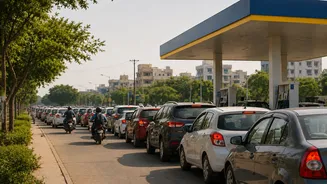







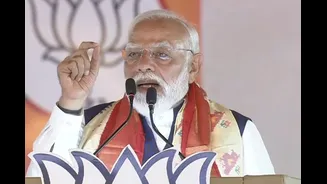
Prime Minister Narendra Modi said it in as many words twice in 24 hours: India has no big oil wells. Nearly 88% of every litre of petrol and diesel burnt
on Indian roads is imported, paid for in dollars, and exposed to every war and chokepoint the world throws at us. When he asked citizens to act, he was not speaking in abstractions. Here is what you can actually do — with hard numbers behind each choice. 1. Take the metro. Just twice a week. India now has 1,086 km of operational metro network across 21 cities, with Delhi, Mumbai, Bengaluru, Hyderabad, Chennai, Pune, Ahmedabad, Kochi and others all connected. The Delhi Metro, according to Delhi Metro Rail Corporation (DMRC) data, alone carries an average of 46.3 lakh passengers daily. A standard car doing a 10-km urban commute burns roughly half a litre of petrol in stop-and-go traffic. Switching that trip to metro twice a week saves approximately 4 litres a month per commuter and eliminates the parking cost, the toll, and the contribution to a city's import bill. If you live in a metro-connected city, using the system even two days a week is the single easiest fuel-saving decision you can make. 2. Carpool. The Economics Survey has done the maths. This is not a lifestyle suggestion – it is an estimate from the Government of India's own Economic Survey 2024-25, presented in the Lok Sabha. Widespread carpooling could eliminate 780,000 daily trips and save 380 million litres of fuel annually across India, the survey found. For the individual commuter sharing a 20-km daily round trip with one colleague, the saving is roughly Rs 2,000–2,500 a month in petrol costs at current pump prices. Several apps operating in most major cities. Maharashtra has formally legalised app-based carpooling. Karnataka has confirmed it is not banned. There is no paperwork. There is only a decision that the rest could take.
3. Switch your two-wheeler to electric. The running cost is already settled.
India sold 1.4 million electric two-wheelers in FY2026, a 22% year-on-year increase, according to Vahan portal data. The reason is simple arithmetic. Electric two-wheelers already offer a total cost of ownership of Rs.1.48 per km, against Rs.2.46 per km for petrol equivalents, according to a June 2025 study by the Council on Energy, Environment and Water (CEEW). For a rider doing 1,500 km a month, a modest commute in any Indian city, that gap translates to savings of roughly Rs.1,500 every month, or Rs.18,000 a year. The upfront cost premium on electric scooters has narrowed considerably since the FAME II subsidy regime and state-level incentives kicked in. The running case for switching is now unambiguous.
4. Work from home — at least one day a week.
PM Modi specifically recalled the systems India built during COVID-19: work from home, online meetings, video conferences. They reduced commuting, cut fuel bills, and did not collapse productivity. One WFH day a week for an urban office worker doing a 15-km commute eliminates roughly 120 km of car travel a month. At 12 km per litre on urban roads, that is 10 litres of petrol, approximately Rs.1,040 at current Delhi pump prices, saved without any change in output. For companies with 500 employees doing a similar commute, one mandatory WFH day a week collectively removes the equivalent of tens of thousands of litres from the monthly import ledger. This requires no infrastructure investment. It requires only a calendar decision.
5. Move goods by rail, not by road.
This one is for business owners, manufacturers, and logistics managers. Road freight in India runs almost entirely on diesel. Indian Railways, which connects over 7,000 stations across the country, runs a significant portion of its freight operations on electricity — much of it generated from domestic sources. The Ministry of Railways has been actively building freight capacity. Shifting even a portion of regular goods movement from trucks to rail reduces diesel consumption directly, lowers per-unit logistics costs over distance, and removes heavy vehicles from highways. PM Modi specifically called out this shift in the Hyderabad speech. For any business moving goods regularly over 300 km or more, the freight rate and fuel calculation almost always favours rail.
None of these five actions requires waiting for policy, a new budget, or a government scheme. They are available this week, in most Indian cities, to most working adults. Aggregated across 1.4 billion people, they add up to something the government cannot manufacture on its own: a measurable dent in the 88% crude oil import dependency that cost India a net oil import bill of $96.1 billion in FY2024, according to ICRA's analysis of Petroleum Planning and Analysis Cell data – a number that has only climbed since.