
Finance Minister Nirmala Sitharaman will announce Union Budget 2026-27 on February 1. Over the last five years, the Union Budget has increasingly positioned
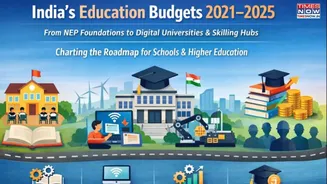
education as a key pillar of the country's growth strategy. From laying the groundwork for the National Education Policy (NEP) to expanding digital learning, the budgets from the past five years have highlighted a wide range of reforms affecting schools, higher education institutions, teachers, and even youth. Have a look at the budget allocated to the education sector over past five years. Education Budget 2021 | Laying the NEP Foundation The Union Budget 2021 focused on aligning education reforms with the National Education Policy (NEP). The government proposed amendments to the Apprenticeship Act to expand youth employment opportunities. An allocation of Rs 3,000 crore was made to realign the National Apprenticeship Training Scheme (NATS) towards post-education apprenticeships for engineering graduates and diploma holders. In school education, 15,000 schools were identified for comprehensive strengthening by implementing all NEP components, positioning them as exemplar institutions. The Budget also announced the setting up of 100 new Sainik Schools in partnership with NGOs, private players, and states. On higher education, legislation was proposed to establish the Higher Education Commission of India as an umbrella regulator. The Budget also outlined a plan to create city-level academic clusters across nine cities and announced a new Central University in Leh to improve access in Ladakh. Education Budget 2022 | Digital Expansion and Universal Access Post COVID, the Union Budget 2022 marked a strong push toward digital education. The ‘One Class-One TV Channel’ initiative under PM eVIDYA was expanded to 200 TV channels to enhance remote learning access. The government announced plans to set up virtual labs and skilling e-labs to promote critical thinking and simulated learning. High-quality digital content was to be developed and delivered through Digital Teachers. A Digital University was also proposed to provide world-class, personalised education at scale. Education Budget 2023 | Health, Teachers, and Tribal Education In 2023, the education focus widened to include healthcare-linked learning and teacher capacity building. The government announced the establishment of 157 new nursing colleges alongside medical colleges set up since 2014. Teacher training was re-envisioned through innovative pedagogy, ICT integration, and continuous professional development, with District Institutes of Education and Training to be upgraded as centres of excellence. A National Digital Library for Children and Adolescents was announced, alongside encouragement for physical libraries at local levels. The year also saw the launch of the Pradhan Mantri PVTG Development Mission with an outlay of Rs 15,000 crore, covering education, health, housing, and livelihoods. The government announced plans to recruit 38,800 teachers and staff for Eklavya Model Residential Schools. Education Budget 2024 | Youth, Skilling, and Financial Support Union Budget 2024 placed youth at the centre of education and employment policy. A Prime Minister’s package of five schemes was announced to benefit 4.1 crore youth over five years. It was backed by a Rs 2 lakh crore central outlay. For the year, Rs 1.48 lakh crore was allocated to education, employment, and skilling. The Model Skill Loan Scheme was revised to allow loans up to Rs 7.5 lakh with a government-backed guarantee. Additional financial support was announced for students not covered under existing schemes, including loans up to Rs 10 lakh for domestic higher education. Around one lakh students annually will receive e-vouchers with a three per cent interest subvention. Education Budget 2025 | Technology, Innovation, and School Quality Union Budget 2025 emphasised technology-driven learning and school infrastructure. The government announced the setting up of 50,000 Atal Tinkering Labs in government schools over five years. Broadband connectivity under the BharatNet project was extended to all government secondary schools and rural primary health centres. The Bharatiya Bhasha Pustak Scheme was introduced to provide digital Indian-language textbooks for school and higher education. Five National Centres of Excellence for skilling were announced with global partnerships to support manufacturing ambitions. A Centre of Excellence in Artificial Intelligence for education was approved with an outlay of Rs 500 crore. The Budget reiterated the goal of ensuring 100 per cent access to good-quality school education.
Some fulfilments from past years
In 2024, Prime Minister Narendra Modi digitally inaugurated and laid the foundation stone for various projects created at Centrally Funded Higher Educational Institutions under the Ministry of Education, including Sindhu Central University in Ladakh.In the same year, PM e-Vidya was launched as part of the Atmanirbhar Bharat Abhiyaan by the Ministry of Education.The initiative aimed to provide multi-mode access to education through digital, online, and on-air platforms to minimise learning losses, especially in the wake of the COVID-19 pandemic.In 2025, the NIELIT Digital University (NDU) platform was launched in New Delhi. The platform offers industry-focused programs in niche technologies such as AI, Cybersecurity, Data Science, Semiconductors, and allied fields. It provides flexible digital learning modes and virtual labs to equip youth with future-ready skills. Five new NIELIT Centres at Muzaffarpur (Bihar), Balasore (Odisha), Tirupati (Andhra Pradesh), Daman (Dadra and Nagar Haveli and Daman and Diu), and Lunglei (Mizoram) were also inaugurated that year. Even Atal Thinking Labs were established at various centres in India. One can check the complete list here.