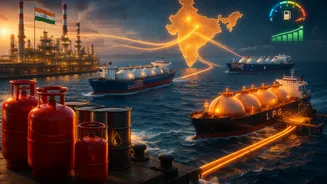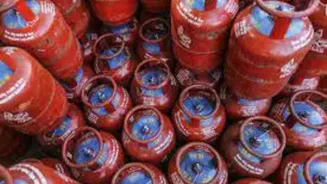





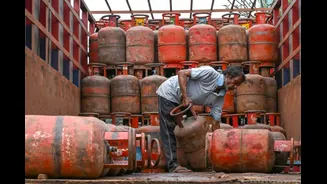

Even as the conflict in the Middle East continues to create uncertainty in global energy markets, India has managed to increase its domestic LPG production
to meet nearly 60% of the country’s total requirement. This is providing some much-needed relief to households and businesses at a time when imported fuel supplies remain under pressure. With the Iran-related war now stretching beyond 40 days, the government has been actively working to reduce dependence on imported LPG. One of the key steps taken is encouraging households to switch from LPG to piped natural gas (PNG). In the last five weeks alone, more than 4.05 lakh new connections have been converted to PNG, and over 4.41 lakh new consumers have been registered for the service. Sujata Sharma, Joint Secretary in the Ministry of Petroleum and Natural Gas, said on Friday that the expansion of the PNG network is picking up speed with active support from state governments and Union Territories. She expressed confidence that the pace of conversion would increase further in the coming weeks. Despite the geopolitical tensions, officials confirmed that there is no shortage of LPG in the domestic market. Distributors across the country have sufficient stocks, and household supply remains stable. Commercial LPG supplies, which had faced some strain earlier, have now recovered to nearly 70% of normal levels. Priority is being given to essential services and critical sectors. Hospitals, schools, hotels, dhabas, pharmaceutical units, packaging industries, and labour-intensive sectors continue to receive uninterrupted supply. To support vulnerable sections of society, the government has doubled the supply of 5 kg LPG cylinders and relaxed documentation requirements. As a result, nearly one lakh such small cylinders are now being sold every day.Since March 14, commercial LPG sales have reached around 1,06,000 tonnes, with daily consumption stabilising between 6,000 and 6,500 tonnes. The government has also conducted more than 2,400 awareness campaigns in the past week to educate consumers about alternative fuel options and improve access. In the natural gas segment, domestic consumption continues to get top priority. Industries connected to the gas grid are currently receiving about 80% of their normal requirement, while supplies to the fertiliser sector have been restored to 95%.City gas distribution companies have been directed to ensure uninterrupted supply to critical areas such as food processing units, cold storages, and healthcare facilities. Additionally, around 800 tonnes per day of petroleum products are being allocated specifically to pharmaceutical and petrochemical industries to keep essential manufacturing running smoothly. Officials said crude oil inventories remain comfortable and refineries are operating at near-optimal capacity. The government’s focus remains on maintaining steady fuel supply while gradually reducing dependence on imports from the volatile Middle East region.