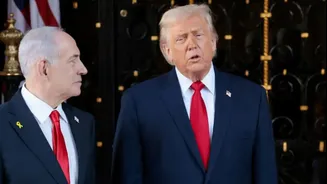









Israeli Prime Minister Benjamin Netanyahu is set to meet US President Donald Trump on Tuesday in their first face-to-face meeting since the two leaders
launched a joint war against Iran, a high-stakes encounter that comes as tensions between the allies deepen and both leaders face mounting pressure at home. For Netanyahu, the meeting is an opportunity to repair a relationship with Trump that has come under strain as he battles for political survival and prepares for re-election. Trump, meanwhile, is facing growing calls to bring the war to an end as its economic fallout drives up prices and threatens to become a political liability ahead of the November midterm elections. The pressure on Netanyahu extends beyond Washington. Israel has seen its bipartisan support in the United States erode, particularly over its conduct of the war in Gaza, adding another layer of complexity to the Israeli premier’s relationship with the Trump administration. US Vice President JD Vance had warned Israeli officials in June that Trump was their "only friend" among world leaders. Vance is also expected to attend Tuesday’s meeting, according to a person familiar with the plans who spoke on condition of anonymity because they were not authorised to discuss them publicly. The meeting, therefore, comes at a delicate moment for both leaders, with Netanyahu seeking to steady ties with his most powerful ally and Trump under pressure to decide how far he is willing to go to sustain a war that is increasingly carrying political costs at home and abroad.
What's on agenda?
The two leaders plan to discuss the framework agreement the US and Israel signed with Lebanon over the Israel-Hezbollah war and the expansion of the Abraham Accords, according to a White House official, who spoke on condition of anonymity to preview the meeting.
"We have a little difference," Trump said Monday when asked by reporters if he and the Israeli prime minister were on the same page with Iran. "But pretty close, yeah."
Netanyahu, who wanted to continue the fighting in Iran and against its ally, Hezbollah, in Lebanon, has been sidelined as Trump sought a deal with Tehran.
His visit to the White House this week comes as the disagreements with Trump and Vance have burst into the open over the war in Iran and more.
Netanyahu keeping focus on Iran's nuclear programme
With US-Iran tensions flaring again in recent weeks, Netanyahu plans to share with Trump Israeli intelligence on Tehran's nuclear program, according to a person familiar with Netanyahu's visit, who spoke on the condition of anonymity to AP.
On Fox News Channel's "Sunday Morning Futures" with Maria Bartiromo, Netanyahu said he hoped to sit down with Trump "to hear what he has in mind" for Iran.
"Because I think, in many ways, it's his decision" on how to move forward, Netanyahu said. "If he can do so without returning to intense military fighting, that's fine. Why not?
"But one way or the other, they have to end their nuclear programme," he said of Iran.
Netanyahu also used the interview to warn Iran against attacking his country, saying Israel's response would be "very forceful".
Steps to allow other forces in Gaza, Lebanon
But even as Netanyahu sees an opportunity, he also needs to persuade Trump that he won't play spoiler to US diplomatic and reconstruction efforts in Gaza and in Lebanon, where the president has previously complained that "too many people are being killed" by Israeli strikes. Israel has taken recent steps in both places.
In Lebanon, where the Israeli military occupies much of the south, Israel agreed to allow the Lebanese army to deploy to some villages as part of a "pilot program" testing their ability to secure areas where Hezbollah once operated.
The US State Department said Monday the next round of talks between Israel and Lebanon will take place next week in Rome with a focus on expanding the programme.
On Gaza, Israel's security cabinet green-lit on Sunday a measure that would, in theory, grant entry to the first members of an international stabilisation force outlined last year in a US-backed ceasefire deal between Israel and Hamas.
Few countries have pledged troops for the force, however, and Israel would approve their entry into Gaza on a case-by-case basis.
(With AP inputs)