






Russia has carried out a fresh test launch of its next-generation Sarmat intercontinental ballistic missile, a weapon President Vladimir Putin claims is more
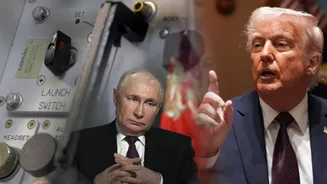
powerful than any Western equivalent and central to Moscow’s evolving nuclear deterrence strategy. The launch, announced on Tuesday, marks another major step in Russia’s long-running effort to modernise its strategic nuclear forces at a time when relations with the West remain at their lowest point since the Cold War. Putin used the occasion not merely to showcase military capability, but to send a broader geopolitical message. “This is the most powerful missile in the world,” the Russian president declared after the launch, claiming that the combined force of the missile’s independently targetable warheads exceeds the destructive capability of Western systems by more than four times.
What Makes The Sarmat Missile Significant?
The Sarmat missile — referred to by NATO as “Satan II” — is designed to replace the ageing Soviet-era Voyevoda system that has formed a core part of Russia’s nuclear triad for decades. According to Putin, the missile will formally enter combat service before the end of 2026.
The Sarmat is classified as a “heavy” intercontinental ballistic missile and is capable of carrying an enormous payload, reportedly up to 10 tonnes. Russian officials say the missile possesses both extended range and advanced manoeuvrability designed specifically to evade missile defence systems developed by the United States and NATO allies.
Strategically, the missile represents more than a hardware upgrade. It reflects Russia’s growing emphasis on ensuring survivable second-strike capability — the ability to retaliate with overwhelming force even after absorbing a nuclear attack. Putin claimed the missile is capable of suborbital flight and has a range exceeding 21,700 miles.
That concern has increasingly shaped Russian strategic thinking since the United States withdrew from the Anti-Ballistic Missile Treaty in 2001 and accelerated development of missile shield systems.
Russian planners have long argued that expanding American missile defences could eventually undermine Moscow’s deterrence posture by intercepting surviving Russian missiles after a hypothetical first strike. “We were forced to consider ensuring our strategic security in the face of the new reality,” Putin said while discussing the programme.
Why The Timing Matters
The Sarmat test comes at a particularly volatile geopolitical moment. Only months ago, the final major nuclear arms treaty between the United States and Russia expired, removing formal caps on the world’s two largest nuclear arsenals for the first time in more than half a century.
That development has intensified fears of a renewed and potentially unconstrained nuclear arms race between Moscow and Washington. At the same time, Russia continues to frame its strategic weapons modernisation as part of the broader confrontation with NATO over Ukraine.
Putin has repeatedly invoked Russia’s nuclear capabilities since launching the full-scale invasion of Ukraine in 2022, often using strategic signalling to deter deeper Western military involvement. The latest launch also followed Putin’s recent remarks claiming the Ukraine conflict was “nearing an end”, comments made shortly after Russia’s Victory Day parade in Moscow — notably conducted without heavy armoured vehicles for the first time in nearly two decades.