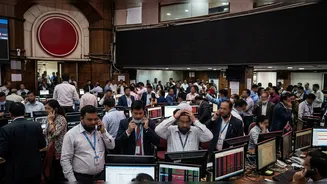








Indian equity benchmarks ended the day in the red zone on Thursday, with persistent foreign institutional investor (FII) selling and a renewed rise in crude
oil prices weighing on market sentiment. The day ended with the BSE Sensex falling 570.59 points, or 0.79 per cent, to 71,909.70. The Nifty 50 declined 198.50 points, or 0.88 per cent, to 22,421.95. The selloff eroded nearly Rs 5 lakh crore from the combined market capitalisation of BSE-listed companies, taking the total below Rs 467 lakh crore. The selloff was broad-based, with most sectoral indices trading in the red. The IT sector was the notable exception, gaining during the session. The weakness was more pronounced across the broader market. The Nifty Smallcap 100 index declined 2.06 per cent, while the Nifty Midcap 100 fell 1.93 per cent, highlighting the extent of risk aversion among investors. The Nifty Auto index emerged as one of the biggest drags, falling around 3 per cent. Bajaj Auto declined 6 per cent, while Mahindra & Mahindra slipped 2.4 per cent after both companies reported a decline in domestic sales. In contrast, the Nifty IT index advanced 0.9 per cent. The gains came after US data showed that inflation increased at a slower pace than expected in August, easing some concerns around the possibility of a US interest-rate hike later this month. FII Selling Remains A Major Market Headwind Foreign investor selling continued to weigh heavily on Indian equities. FIIs extended their selling streak to a fifth consecutive session on September 30, when they sold Indian shares worth more than Rs 10,000 crore. Exchange data showed net FII selling of Rs 10,148 crore during the session. V K Vijayakumar, Chief Investment Strategist at Geojit Investments Limited, stressed the intensity of the recent selling. "The sustained FII selling became intense during the last two trading days when the FIIs sold equity for a total of Rs 20,128 crore. With the US 10-year bond yield rising further to 5.3 per cent, FIIs may continue to sell. An apparent contradiction in the FII activity is that even while selling through the exchanges, they have been consistently investing through the primary market and also buying expensive mid and smallcaps," V K Vijayakumar said. US Bond Yields, Oil Prices Add To Investor Concerns Higher US Treasury yields have added another layer of pressure for emerging-market equities. The US 10-year Treasury yield climbed to levels not seen since 2002, with inflationary pressures, heavy government borrowing and resilient economic growth keeping interest-rate expectations elevated. The 10-year yield rose as much as four basis points to 5.33 per cent, moving above its 2007 peak. The 30-year Treasury rate also reached its highest level since 2002. Rising crude prices added to the pressure, with Brent crude gaining around 2 per cent to $99.70 a barrel. For India, higher oil prices can raise concerns around import costs, inflation and the country's external balances, particularly when the rupee is also facing pressure. Rupee Weakens As Dollar Strengthens The Indian rupee also declined alongside other Asian currencies as the dollar index climbed to a more than three-month high. The move came amid rising US Treasury yields. The rupee fell 0.16 per cent to 95.9850 against the US dollar, remaining above the psychologically important 96-per-dollar mark. At the same time, market volatility increased. The India VIX, often referred to as the market's fear gauge, jumped nearly 11 per cent to 15.01. A rising VIX generally indicates that investors expect greater volatility ahead and are becoming more cautious about market conditions.