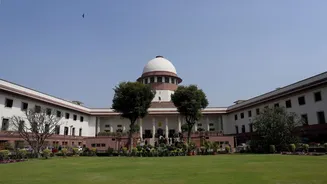








The Supreme Court on Thursday asked the Tamil Nadu government to change its "mindset" and reconsider its opposition to the establishment of Jawahar Navodaya
Vidyalayas (JNVs) in the state, observing that Hindi cannot be completely kept out and urging the Centre and state to resolve the language issue through dialogue. A Bench headed by Justice BV Nagarathna was hearing Tamil Nadu's challenge to an order directing the establishment of Navodaya schools in every district of the state. During the hearing, the court questioned Tamil Nadu's objection to the schools on the grounds of its two-language policy. Justice Nagarathna said the establishment of Navodaya schools was not, by itself, contrary to the state's language policy and asked the government to engage with the Centre on the issue. Senior advocate Jaideep Gupta, appearing for Tamil Nadu, argued that the Navodaya scheme was based on a three-language formula and could lead to Hindi gaining prominence over Tamil. The state has maintained that its statutory two-language policy, centred on Tamil and English, does not permit implementation of the scheme in its present form. The court, however, questioned whether Tamil Nadu could simply refuse to implement a Central government scheme and asked the state to identify land for Navodaya schools in every district. The dispute centres on the language structure followed by JNVs. Tamil Nadu has argued that the three-language formula is incompatible with the Tamil Nadu Tamil Learning Act, 2006. The Union government, however, has told the Supreme Court that in non-Hindi-speaking states, the medium of instruction in Navodaya schools is primarily the regional language or English. The issue has been before the courts for several years. In an earlier round of litigation, a Madras High Court judgment held that the establishment of Navodaya schools would not violate Tamil Nadu's language law, noting that Tamil could remain a compulsory language and that the Centre would bear the cost of establishing the schools, while the state would have to provide land. The Supreme Court had also questioned Tamil Nadu's opposition during an earlier hearing in July, asking why the state should prevent Central government schools from being established and noting that the three-language formula did not necessarily mean Hindi. Tamil Nadu has maintained that the policy is optional and that courts cannot compel a state to implement a government scheme. The Supreme Court, meanwhile, stressed the need for dialogue and cooperative federalism between the Centre and the state. In its latest order, the court granted Tamil Nadu three months to comply with the directions. It also directed representatives of the Centre and the state to hold further discussions on the policy and the establishment of the schools. The matter has been posted for December 14.