






The Jupiter becomes the brightest and biggest it will appear all year as it officially reaches opposition at 4 am EST, placing Earth directly between the Sun
and the giant planet. This alignment makes Jupiter shine at its peak and stay visible all night, rising at sunset and setting near sunrise. Adding to the spectacle, Jupiter’s moon Callisto crosses the planet’s face at the same time, moving together with its shadow. This rare alignment is only possible at opposition and gives skywatchers a chance to see a double event using binoculars or a small telescope. The Jupiter is easy to find in the night sky. It sits in the constellation Gemini, about 7 degrees southwest of the bright star Pollux. Shining at magnitude 2.7, the planet is brighter than every star in the Northern Hemisphere except Sirius, making it impossible to miss on a clear night.
What Makes Jupiter’s Opposition Special For Skywatchers?
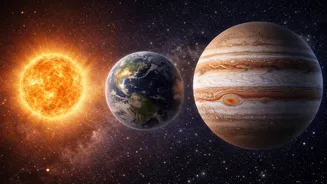
At opposition, Jupiter is at its closest point to Earth for the year. This makes the planet appear larger and brighter than at any other time. As the Sun is directly behind Earth, sunlight hits Jupiter straight on, reducing shadows and improving surface visibility.
READ ALSO | 'Drive Baby Drive:' Rebecca Good's Comment From Bodycam Footage Sparks Arrest Calls On Social Media
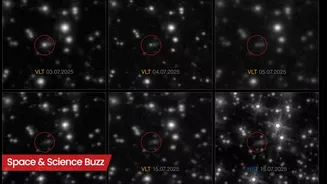
This is also why Callisto’s transit is unusual. As the moon crosses Jupiter’s cloud tops, its shadow travels directly beneath it, appearing overlapped rather than separated. Around 4 am EST, Callisto sits near the center of Jupiter’s disk, and careful observers may notice a slightly darker or distorted edge caused by the shadow blending with the moon itself.
The transit continues until shortly after 6 am EST, about an hour before sunrise on the US East Coast, giving observers plenty of time to watch or photograph the event.
How Can You Spot Jupiter And Its Moons Tonight?
Jupiter rises in the east after sunset and climbs higher as the night goes on. In the early evening, it appears near Pollux, with Castor and Pollux, the twin stars of Gemini, framing the scene. From Earth’s view, these stars appear close together, even though they are separated by vast distances in space.
READ ALSO | Was Renne Nicole Good 'ICE Watch Warrior'? What We Know About Viral Claims
Even simple binoculars reveal Jupiter’s four largest moons, Io, Europa, Ganymede, and Callisto, first observed by Galileo in 1610. Io, roughly the size of Earth’s Moon, is the most volcanically active body in the solar system. Jupiter itself is a massive world, large enough to hold 1,300 Earths, with violent winds, colorful cloud bands, and the famous Great Red Spot, a storm larger than our planet.