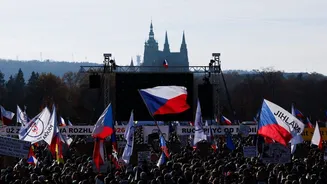









Tens of thousands of people filled the streets of Prague on Sunday to protest a government plan that would change how Czech public television and radio
are paid for. Critics say the plan would weaken the broadcasters and put their independence at risk. The government of Prime Minister Andrej Babis wants to scrap the monthly broadcasting fee that households pay. The fee is 205 crowns, or about $9.26. Under the bill, public media would be funded from the state budget instead. The bill has passed a preliminary vote and is waiting for more debate. The government is led by billionaire Babis and backed by the hard-right SPD and the eurosceptic Motorists parties. It accuses both private and public Czech media of bias. Babis says the move simply keeps a promise to ease the financial burden on ordinary people.
Why critics are worried
Opponents say that paying for public media out of the state budget would weaken its link with the viewers who pay for it today. They argue it would also leave the sector open to political pressure.The money is another concern. The plan includes a 15% funding cut, which would bring television’s nominal budget down to its 2008 level and radio’s to its 2005 level. According to Reuters, media organizations say that is not workable.
Some critics have compared the bill to changes made in Hungary under former Prime Minister Viktor Orban, who built a large network of pro-government media.
Opposition parties and civic groups were also angry about how the first version of the bill was passed. The government rushed it through in the middle of the night in October. They want the ruling coalition to withdraw the law.
A huge turnout
The protest took place in Letna park, which looks over the Czech capital. Crowds also packed nearby metro stations. Speakers included students, soldiers and former dissidents who signed the Charter 77 initiative.Protesters carried signs reading “Hands off the media” and “Let media deal with politicians.” Many wore pointed hats folded from newspaper. The hats were a nod to an animated character who has introduced Czech Television’s nightly bedtime stories for children for decades.
Organizers said turnout was already higher than at an anti-government rally in March that drew more than 200,000 people. They predicted it could become the biggest demonstration since the Velvet Revolution of 1989, which ended Communist rule and brought the dissident playwright Vaclav Havel to power.
The rally came days before November 17, a public holiday marking the start of the Velvet Revolution.