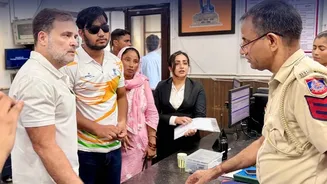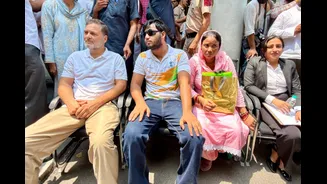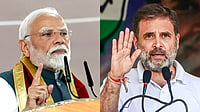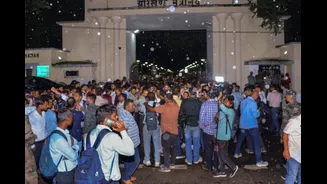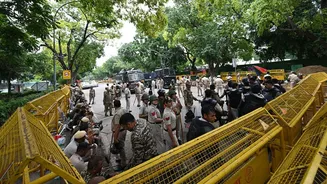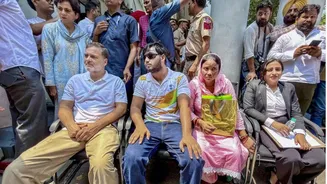



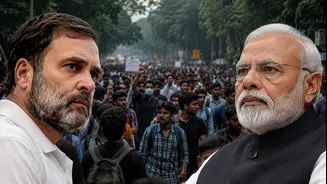
Congress leader and Leader of Opposition Rahul Gandhi is sitting on a dharna at the Parliament Street Police Station in the national capital on Friday,
demanding an FIR over the alleged use of pellet guns during the Cockroach Janta Party (CJP) protest on July 20. Gandhi sought registration of an FIR over pellet injuries suffered by a youth, Sahil Lochav, during the protest. As Gandhi alleges that the Delhi Police is yet to register an FIR, the question of whether law enforcement can legally refuse to file an FIR has come into sharp focus. Under Indian law, the answer is nearly no — once a complaint discloses a cognizable offence, registration is not discretionary, though the process and exceptions are more layered than they may seem. Lochav, who reportedly suffered pellet injuries to the eyes and abdomen, and later underwent surgery at the AIIMS Trauma Centre, had first approached Delhi Police with a written complaint through his lawyers on August 14, but was not given an Investigating Officer (I/O) number, Congress sources said. The matter was pursued again on August 17 through email and phone calls, but neither an I/O number nor an acknowledgment was provided and with the police still refusing to assign a case officer or register an FIR despite it being a cognisable offence, Rahul Gandhi accompanied the victim to the DCP office to insist on both the I/O number and the FIR, they added. Under the Bharatiya Nagarik Suraksha Sanhita (BNSS), 2023, which replaced the CrPC, Section 173 requires police to register an FIR when information discloses a cognizable offence. This obligation flows from the Supreme Court's landmark 2014 ruling in Lalita Kumari vs Government of Uttar Pradesh, where the top court held that if information on its face discloses a cognizable offence, police have no discretion and must register the FIR. Advocate Avishkar Singhvi, speaking exclusively with Times Now Digital, explained that under the existing legal framework, police "ordinarily have no discretion to simply refuse to register an FIR" once a complaint discloses a cognizable offence. "The position is now contained in Section 173 of the Bharatiya Nagarik Suraksha Sanhita (BNSS), 2023, which corresponds substantially to the old Section 154 of the CrPC," he said. Singhvi noted that under Section 173(3) of the BNSS, police may conduct a preliminary enquiry only for offences punishable with three to seven years' imprisonment, adding that "unless there is abnormal, inordinate, palpable delay, the FIR must be registered," in line with the Supreme Court's Lalita Kumari ruling, which continues to be "followed consistently." He further said that if police refuse registration, "the complainant has recourse to approach the magistrate to seek registration under Section 175(3)," which was earlier Section 156(3) of the CrPC, adding that police discretion is comparatively higher in non-cognizable offences, which usually carry lesser punishment. Rahul Gandhi, in a post on X (formerly Twitter), said, "Sahil wants to file an FIR for justice, even that is not being allowed. In this way, the Constitution and constitutional rights are being trampled upon. Amit Shah ji, why are you so scared of justice? This fear shows that you are admitting to your crime." "The FIR will be filed. A judicial inquiry will take place. And action will be taken against everyone—from top to bottom—who is guilty of this brutality. We will ensure justice for Sahil, and every student victim like him," he added. Gandhi, accompanied by the youth, Sahil Lochav, first visited the Mandir Marg police station and sought the registration of the FIR. After his demand was not accepted, he went to the Parliament Street police station and met the deputy commissioner of police (DCP). After the discussions with the DCP failed, the leader of the opposition in the Lok Sabha sat on a dharna at the police station. Senior Congress leader Salman Khurshid, while speaking exclusively to Times Now, also pointed out that any "cognizable complaint should be converted into an FIR." Meanwhile, Delhi Police sources told Times Now that a complaint was submitted by the victim. According to police, the complaint will be forwarded to the Crime Branch, which is investigating all cases registered on July 20, they said, adding that police said legal action will be taken as per law. The Supreme Court has formed a five-member high-powered committee headed by former top court judge Justice R Subhash Reddy to examine allegations of police excesses against student protesters in Delhi recently and violence against police personnel. The committee has been asked to examine use of excessive force and violence against protesters by police, including the deployment of pellet guns, as well as the alleged use of force and violence by protesters against police officials and other security personnel.