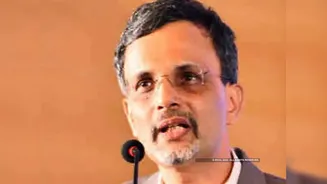







India’s Chief Economic Advisor V Anantha Nageswaran has highlighted the need for bringing back a lower ethanol blend such as E10 for older vehicles and
stressed on the need for a thorough cost-benefit assessment before India commits to higher ethanol blending. In an opinion piece in The Indian Express, Nageswaran, the CEA, who co-authored it with Akash Poojari, a consultant in the Department of Economic Affairs, argued that the debate over E20 should move beyond concerns over possible engine damage and focus on the wider food-versus-fuel trade-off, such as the impact of diverting land and water towards ethanol production. The CEA said suggested that a lower blend at the pumps could address the issue for older vehicles without abandoning the E20 programme altogether, "bring back a lower blend, such as E10, for the older fleet of vehicles. Fix the price and water distortions that unintentionally favour maize over other crops, relook at the import duty on edible oil to support the push towards domestic self-sufficiency, and hold at E20 until India has thoroughly costed the food-versus-fuel trade-off, rather than assuming it away," he stated. The opinion piece authored by V Anantha Nageswaran and Akash Poojari further explained, "ethanol carries about two-thirds the energy of petrol, so a litre of E20 takes you a little less far, but the loss is small and does not signal any malfunction. Ethanol is only a fifth of the blend, so the energy penalty is around 6 to 7 percent, not the 30 percent doing the rounds. Carbon monoxide and unburnt hydrocarbons actually fall, which is good for the environment. On durability, which is the primary point of contention, the record is reassuring and counters the online narrative. The US, one of the global leaders in ethanol blending, had the Oakridge National Laboratory run 86 vehicles for a cumulative total of nearly 10 million kilometres on blends up to E20 and found no increased wear in cars not rated for E20. India’s own testing by ARAI, the petroleum institute, and Indian Oil reached the same conclusion. Thus, social-media worries about engine damage do not hold up. However, one exception is genuine, that is, India has roughly 75 to 80 million older two-wheelers built before BS4 that run on carburettors. A carburettor cannot sense the extra oxygen in the blend and adjust for it, so on E20, the engine draws in too little fuel for the air it draws in and runs hot. Further, older rubber seals that are not rated for ethanol are a separate problem, as they degrade on contact with the fuel regardless of engine temperature. Retrofitting those seals with ethanol-compatible ones is cheap. Still, it happens one vehicle at a time, and covering 75 to 80 million two-wheelers that way will take years, even if every workshop starts today. The original roadmap anticipated this and requested that a lower-blend fuel remain on sale for these vehicles, but that fuel quietly vanished from the pumps and needs to return. Restoring a lower blend at the pumps, say, E10, alongside the option to buy E20, would calm most public concern, lower total ethanol use instead of raising it, and protect the existing fleet while the retrofit programme catches up." The authors highlight how the engine row is not the real issue but what we choose to grow, and what we will not be able to take back.