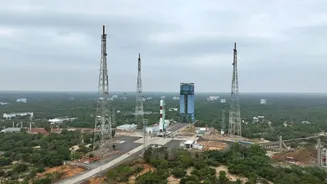

New Delhi: ISRO is set to kick off its 2026 launch calendar with the PSLV-C62 mission on Monday, January 12, at 10:17 am from the first launch pad at the Sriharikota
spaceport. The rocket will place the advanced Earth-observation satellite EOS-N1, code-named Anvesha, into orbit-adding another powerful “eye in the sky” to strengthen India’s space-based surveillance capabilities. Along with the primary payload, PSLV-C62 will also deploy a European technology demonstrator satellite and 17 additional satellites from Indian and international agencies. EOS-N1 is a hyperspectral imaging satellite developed mainly for DRDO. It can capture data across hundreds of wavelengths, allowing precise identification of materials on the ground, making it a critical asset for national security and surveillance. The satellite will strengthen India’s border monitoring capabilities and also support applications in agriculture, urban planning, and environmental monitoring.
PSLV-C62 will carry EOS-N1 and 15 co-passenger satellites.
EOS-N1 and 14 co-passengers are planned for injection into Sun Synchronous Orbit; the KID capsule is planned for a re-entry trajectory.
🗓️ 12 Jan 2026 | 🕘 09:45 IST onwards
🚀 Liftoff at 10:18:30 IST
Livestream link:… pic.twitter.com/PZrd1CpgR8— ISRO (@isro) January 11, 2026
In addition to EOS-N1, the mission will carry 18 secondary payloads, including Europe’s Kestrel Initial Demonstrator. The KID mission will test the experimental re-entry of a small capsule developed in collaboration with a Spanish startup, with a planned splashdown in the South Pacific Ocean.
The remaining secondary payloads include CubeSats developed by Indian startups and universities, such as CGUSAT-1 from CV Raman Global University, DA-1 by Dhruva Space, SR-2 from Space Kidz India, Lachit-1 by Assam Don Bosco University, Solaras-S4 by Akshath Aerospace, and DSAT-1 from Dayanand Sagar University. OrbitAID Aerospace will also create history with AayulSAT, India’s first on-orbit satellite refuelling experiment.