






The Congress on Tuesday raised questions over the government's notification on UPI transactions, claiming that a stage is clearly being set for people
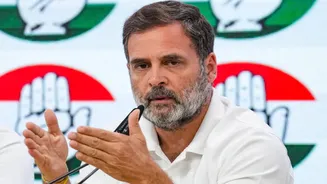
to pay a fee for such transactions and asking whether this is being done to open digital payments for American firms to "appease" US President Donald Trump. In a post on X, Leader of Opposition (LoP) Rahul Gandhi alleged that the government has quietly paved the way for imposing fees on UPI transactions and that a "compromised" Prime Minister Narendra Modi was "once again surrendering" to American pressure. "The Modi government has quietly opened the door to imposing fees on UPI. Now, MDR can be levied on merchant UPI transactions above ₹2,000. Even if these transactions account for just 5% of the volume, they make up nearly 65% of UPI's total transaction value. The government says no fees will be charged to customers. But where will the fees imposed on shopkeepers ultimately come from? Added to prices, straight out of the customer's pocket," Gandhi wrote on X. "American payment companies have long opposed India's zero-MDR policy. Now, the Modi government has opened the path to changing the policy in exactly that direction. Just like with the US Trade Deal, Compromised PM Modi is once again surrendering to American pressure," he added.
UPI Payments Up To Rs 2,000 Remain Free
Gandhi's attack came after the government directed banks and payment system providers not to levy charges on Unified Payments Interface (UPI) transactions of up to Rs 2,000 or on payments made through RuPay debit cards.
However, the government has not specified whether charges would be applicable to transactions above Rs 2,000, to be paid by merchants. So far, there has been no charge on UPI transactions, irrespective of the amount.
The amendment bill was passed by Parliament during the Monsoon Session, which concluded on August 13, 2026. Following the passage of the Bill, the government had said the UPI and Services Steering Committee, headed by the National Payments Corporation of India (NPCI), would decide on the MDR rates.
Explaining the rationale for imposing charges, the government, in a statement, said, with exponential transaction volumes, the system requires significant and continuous upgrades in cybersecurity, fraud prevention, and infrastructure.
Charges were required for market expansion and self sustainability, it had said. It is necessary to increase competition by encouraging more companies to expand their operations, which requires a self-sustaining revenue model, it had said.
Reliance on subsidies alone is not viable for the next wave of growth, it said, adding that a balanced framework is required to ensure that UPI remains robust, inclusive, and future-ready.
UPI is operated by the National Payments Corporation of India (NPCI), an initiative of the Reserve Bank of India (RBI) and the Indian Banks' Association.
(With agency inputs)