




Say cheese. Hold still. And wait. In the 19th century, having your photograph taken was nothing like it is today. Exposures were slow, the equipment cumbersome
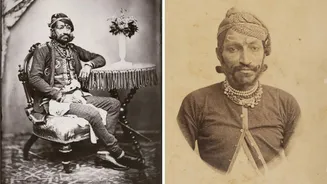
and the process laborious. But Indian kings and their shauks were not ones to be held back. Maharaja Sawai Ram Singh II (September 28, 1833 to September 17, 1880) of Jaipur became enamoured with the new medium. It earned him a rather unusual title: the “Photographer Prince of India”. During his lifetime, Ram Singh II created more than 6,000 individual photographs and nearly 2,000 glass plate negatives. He was also a lifelong member of the Bengal Photographic Society. On World Photography Day, his archive offers a fascinating glimpse into a time when photography was still finding its place in India. The son of Maharaja Jai Singh III of Jaipur, he ascended the throne in 1835, following his father's death. The first nine years of his life were spent inside the Zenana. Jaipur was governed by a regent as he was still a toddler, until he came of age and formally became the Maharaja. He learnt photography through the British photographer T. Murray during his visits to India. Murray was later appointed court photographer between 1867 and 1870, following numerous visits to Jaipur. “His passion for photography is evident from the personal studio at his court, called the photukhana or tasveer khana, meaning ‘the picture department’, where he housed his extensive collection of cameras and processing equipment and developed his images,” states Impart. His photography was done using large-format wooden wet-plate cameras, including a wet-plate sliding box camera made by J. Spencer and a stereo box camera by J.H. Dallmeyer, fitted with brass portrait lenses by Voigtländer & Sohn. His talent as a photographer came to light more fully after his death in 1880. The collection of his prints and glass plate negatives is now housed at the Maharaja Sawai Man Singh II Museum in Jaipur. His glass plate negatives are among the best-known parts of the collection. In the era of selfies, the Maharaja's skill with self-portraits feels particularly striking. He repeatedly turned the camera on himself, experimenting with his appearance and persona. Yet there have been debates about how the Maharaja managed to capture these self-portraits in the 19th century. Did a servant or court assistant operate the camera according to his directions, or did he use long exposures, carefully positioning himself before the lens? Dignitaries visiting Jaipur also became subjects for the Maharaja's camera. His interest extended to architectural marvels and landscapes in cities such as Agra, Varanasi, Lucknow and Calcutta, now Kolkata. He travelled across India carrying his camera equipment, turning the new technology into a means of documenting the places and people he encountered. “His photographs of foreign men and women follow the conventional portrait format, but with the subjects posed against backgrounds he painted himself. He would also experiment with the photographs, often superimposing the subjects’ faces on different bodies,” states Impart. The portraits of women from the Zenana, a world few outside the palace could ever glimpse, remain among his most famous photographs. “They show many individual South Asian women: some look away, others dress up and pose, and several stare down the photographer (and today’s viewer), challenging both to uncover their personalities and stories,” states the Museum of Art & Photography (MAP). Perhaps having spent his early childhood in the Zenana made it easier for Ram Singh to connect with the women he photographed there. But the circumstances surrounding these portraits remain difficult to establish. The identities of many of the women are unknown, and they did not include his wives. Some have been described as courtesans or women associated with the royal household, although such classifications are not always certain. The Maharaja also documented the everyday activities of his life in a journal, which included details of the people he photographed. His entries recorded the process of developing prints from glass negatives, as well as the problems he encountered during the photographic process. For Ram Singh, photography was more than a royal pastime. It was a new technology that allowed him to document his world, experiment with his own image and create a visual record of Jaipur at a time when photography itself was still in its infancy.