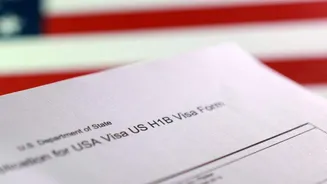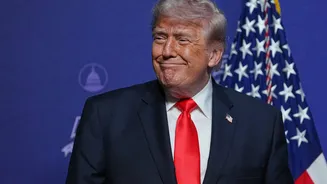




In a big setback to the Donald Trump administration, a federal judge on Monday ruled that the USD 100,000 fee imposed by the US President for H-1B applications
was "unlawful" as it did not have the approval of Congress. After the verdict, US-based Indian diaspora advocacy groups welcomed the Massachusetts federal court's decision, asserting that it was appropriate for preserving America's competitive edge in innovation and entrepreneurship. At the same time, they wondered whether this would truly be the end of the matter. "We welcome the Massachusetts federal court's decision striking down the USD 100,000 H-1B visa fee, which restores predictability and fairness to the employment-based immigration system," Khanderao Kand, Chief of Policy and Strategy at the Foundation for India and Indian Diaspora Studies (FIIDS), told PTI. "All stakeholders connected with H-1B visas will heave a sigh of relief after the court order, but one wonders if this is truly the end of the matter," Sanjeev Joshipura, Executive Director, Indiaspora, told PTI. Indian nationals account for the overwhelming majority of H-1B visa holders in the United States. Also Read: Where Does India Stand on H-1B Visas? The Numbers Behind the Dominance Explained
Why the H-1B Visa fee matters for Indian immigrants
The H-1B program has long stood as a cornerstone of America's high-skilled immigration system. The visa, originally designed to plug workforce shortages, has now evolved into a powerful driver of cross-border exchange.
For India, it has become a symbol of aspiration and upward mobility, powering a new generation of professionals who see the visa as their ticket to opportunity. For the United States, it has meant a steady influx of engineers, researchers, and physicians, skilled minds filling crucial gaps in laboratories, classrooms, hospitals, and start-ups.
Kand said the court ruling was appropriate for preserving US' competitive advantage in innovation, research, and entrepreneurship.
"Access to highly skilled global talent remains essential for the continued growth of US' technology, healthcare, and advanced manufacturing sectors. The judgment reinforces the principle that major policy changes must be grounded in statutory authority and economic realities," he said.
Why the path ahead may not be that easy
Joshipura, however, struck a note of caution, saying the US administration might still create hurdles for H-1B visa holders through procedural matters that may not run afoul of the law.
"If the executive branch wishes to impose impediments on H-1B visa holders, as per the administration's stated policy preferences, then they might still be able to do so through procedural means that do not run afoul of US law," he said, citing the recent tussle between the administration and the judiciary.
In September last year, Trump signed a proclamation adding the USD 100,000 fee for new H-1B visa applications.
According to data from the US Citizenship and Immigration Services (USCIS), the country-wise breakdown of H-1B visa allocations for 2024 shows how India overwhelmingly dominates the list. India accounts for more than 70% of all H-1B visas issued in 2024. The number of Indian nationals (283,397) is over six times higher than the next highest, China (46,680).
(With agency inputs)