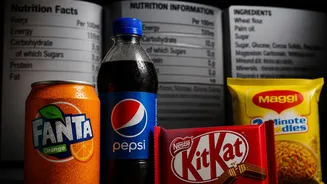









A can of Fanta on a London shelf carries 63 calories. The same brand in India holds nearly three times the sugar — and an artificial dye that, in Europe,
legally demands a prominent health warning. In India, that same ingredient sits in small print on the back of the can. Times Now Digital put that gap directly to the three companies that dominate India's packaged food and drink shelves — Coca-Cola India, PepsiCo India and Nestlé India — asking why the same brands carry different formulations and different warnings across markets, and whether Indian consumers get the same transparency as buyers in Europe. Times Now Digital also sent similar queries to the Food Safety and Standards Authority of India (FSSAI), the regulator at the centre of the row, seeking its position on the formulation and labelling gap. The queries were sent on August 26; FSSAI did not respond. This report will be updated if it does. All three companies responded. None disputed that their products differ from country to country. What they defended, instead, was their compliance with whatever the local rules happen to be. Nestlé India was the most direct on the point. "Product formulations may vary across countries due to differences in local regulations, consumer preferences, nutritional requirements and ingredient availability," its spokesperson said, adding that the company remains "committed to transparent labelling, clear consumer information and full compliance with applicable regulations in every market where we operate. We continuously evolve and improve our products while ensuring consumers have the information they need to make informed choices." That answer lands at a delicate moment. In August, FSSAI dropped plans to mandate colour-coded interpretive warning labels on the front of packaged foods, the kind that flag high sugar in red, and proposed a muted black-and-white table of sugar, salt and fat content instead. Its reasoning: Indian cuisine's intense flavours make global labelling standards a poor fit. The decision is now before the Supreme Court, which took it up after public health activists petitioned. The stakes are stark. A recent study in The Lancet found up to 450 million Indians could be overweight or obese by 2050, and roughly 20 countries have already adopted the very front-of-pack labels that India hasn’t looked at, according to a Reuters investigation. Against that backdrop, Coca-Cola India's response is notable for what it claims to support. "We add clear, easy-to-find nutrition information on our products, in line with local regulations, so that consumers can make informed choices that fit their diet and lifestyle," its spokesperson told Times Now Digital. "We support science-based interpretative front-of-package nutrition labelling, as it can be useful to help people make informed choices and help companies innovate. As a total beverage company, we continue to offer consumers more choices across our portfolio, including expanding the availability of low- or no-calorie beverages and smaller package options," the company said. Coca-Cola says it supports interpretive front-of-pack labelling — the same system FSSAI has now abandoned. Yet the Reuters investigation, drawing on recordings of a March 19 meeting between the regulator and industry, reported that a senior Coca-Cola India executive told FSSAI it was reductive to assume a consumer who does not already read ingredient lists would improve their diet on the strength of a warning symbol and argued such labels would not change consumption anyway. In Europe, meanwhile, Coca-Cola and its bottlers voluntarily carry traffic-light labels across some two dozen markets — labels its Swiss affiliate Coca-Cola HBC calls "clear and transparent" on its own website. After the March meeting, FSSAI told the court it was "difficult" to match international standards, language that closely tracked the industry's own. PepsiCo India, for its part, kept its answer tight and framed it entirely around the rulebook. "PepsiCo India consistently complies with the applicable regulatory standards for all its products and continues to align its packaging and labelling with evolving regulatory requirements and consumer expectations," its spokesperson said. "As a responsible company, we remain committed to maintaining the highest standards of quality, safety, and transparency, while ensuring full compliance with all applicable regulations." Read together, the three statements share a single load-bearing phrase: compliance with local regulations. It is an answer that works cleanly only as long as the local regulations ask for little, which, in India, they increasingly do. None of the three addressed the harder question Times Now Digital posed: whether a rulebook that permits more sugar and quieter warnings than Europe's leaves Indian consumers with less information about the same products. FSSAI, which could speak to exactly that, was asked — and chose not to answer, so far at least. That question now sits with the Supreme Court, which had earlier directed FSSAI to study systems like Israel's red-and-green labelling before finalising its stand. Until it rules, the Fanta in Delhi and the Fanta in London will keep sharing a name — and little else.