







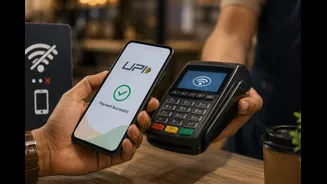

New Delhi: A new charge on some UPI payments will be paid by merchants from October 15, but the government is now working with payment gateways to make
sure the cost is not passed on to customers. The Finance Ministry has started discussions with payment aggregators and other stakeholders in the UPI ecosystem to ensure merchants do not recover the Merchant Discount Rate (MDR) from consumers, government sources told PTI. Notably, banks have been instructed to ensure merchants do not pass the MDR cost on to customers, the ministry of finance clarified on X. Furthermore, the ministry said that UPI apps cannot impose separate platform charges on users.
Govt Works On Mechanism To Protect Customers
From October 15, a 0.4 per cent MDR will apply to person-to-merchant UPI payments above Rs 2,000. The charge will be paid by merchants and will be capped at Rs 300 for transactions of Rs 75,000 or more.
Payments between individuals and most everyday merchant payments will continue to remain free.
The ministry is preparing a monitoring mechanism to ensure that the MDR burden is not passed on to customers, sources said.
🔰 UPI Remains Free for Consumers
UPI continues to be free for customers. Sending money to friends, paying at shops, or scanning a QR code — all remain without charges.
Key Facts:
✅ No charges on P2P: Person-to-Person transfers are always free, regardless of amount.
✅ Small… pic.twitter.com/PyQ7hotNMN— Ministry of Finance (@FinMinIndia) September 16, 2026
Payment aggregators and other stakeholders have already been sensitised about the new charge, with the government seeking to prevent any additional burden on UPI users.
UPI MDR: What The Finance Ministry Says
- P2P payments stay free: Person-to-person UPI transfers will continue to have no charges, regardless of the amount.
- Small merchants protected: Merchants earning up to Rs 1 lakh a month through UPI QR codes will continue to pay no charges.
- Most everyday payments remain free: More than 95% of merchant UPI payments are below Rs 2,000 and will not attract MDR.
- 0.4% MDR on bigger payments: Merchant transactions above Rs 2,000 will attract a 0.4% MDR, to be paid by merchants.
- Rs 5 fee for essential services: Railways, fuel, telecom, bill payments and insurance will have a flat Rs 5 charge for transactions above Rs 2,000.
- Lower rate for investments: Mutual fund and securities payments will attract an MDR of just 0.02%, capped at Rs 300.
- Customers cannot be charged: Banks have been instructed to ensure merchants do not pass the MDR cost on to customers.
- No hidden UPI fees: UPI apps cannot impose separate platform charges on users.
- Govt rejects foreign-pressure claim: The Finance Ministry said UPI policy decisions are made independently and denied claims that the new MDR was introduced due to foreign influence.
- Why the fee: The government says the revenue will help make UPI self-sustaining and support infrastructure, cybersecurity and UPI adoption among smaller businesses and rural users.
- UPI's scale: UPI processed 24.5 billion transactions in August 2026, according to the ministry.
Govt Does Not Expect UPI Users To Shift To Cash
As per the report, citing government sources, only around 4 per cent of total UPI transaction volume will be affected by the new MDR, and therefore the measure is not expected to reduce UPI usage.
On concerns that users could return to cash after October 15, sources said this was unlikely as RuPay debit card transactions remain completely free, regardless of the amount.
The government also does not expect the MDR to have a significant inflationary impact or lead to higher prices for goods and services, sources said.
The Finance Ministry has separately rejected allegations that the MDR was introduced because of US pressure.
"The allegation that MDR has been introduced under any external influence is patently false and misleading," the Department of Financial Services said in a post on X.
The clarification came after Opposition parties, including the Congress, alleged that the government had acted under US pressure while introducing the MDR.
The ministry said the latest NPCI rules do not give international credit cards an advantage over RuPay. The DFS said, "The NPCI circular of September 15, 2026, does not allow credit transactions on UPI by any other credit card other than the RuPay credit card. There is a clear policy of only allowing RuPay credit card on UPI to enable RuPay credit card to become the preferred choice of credit card amongst users in India."